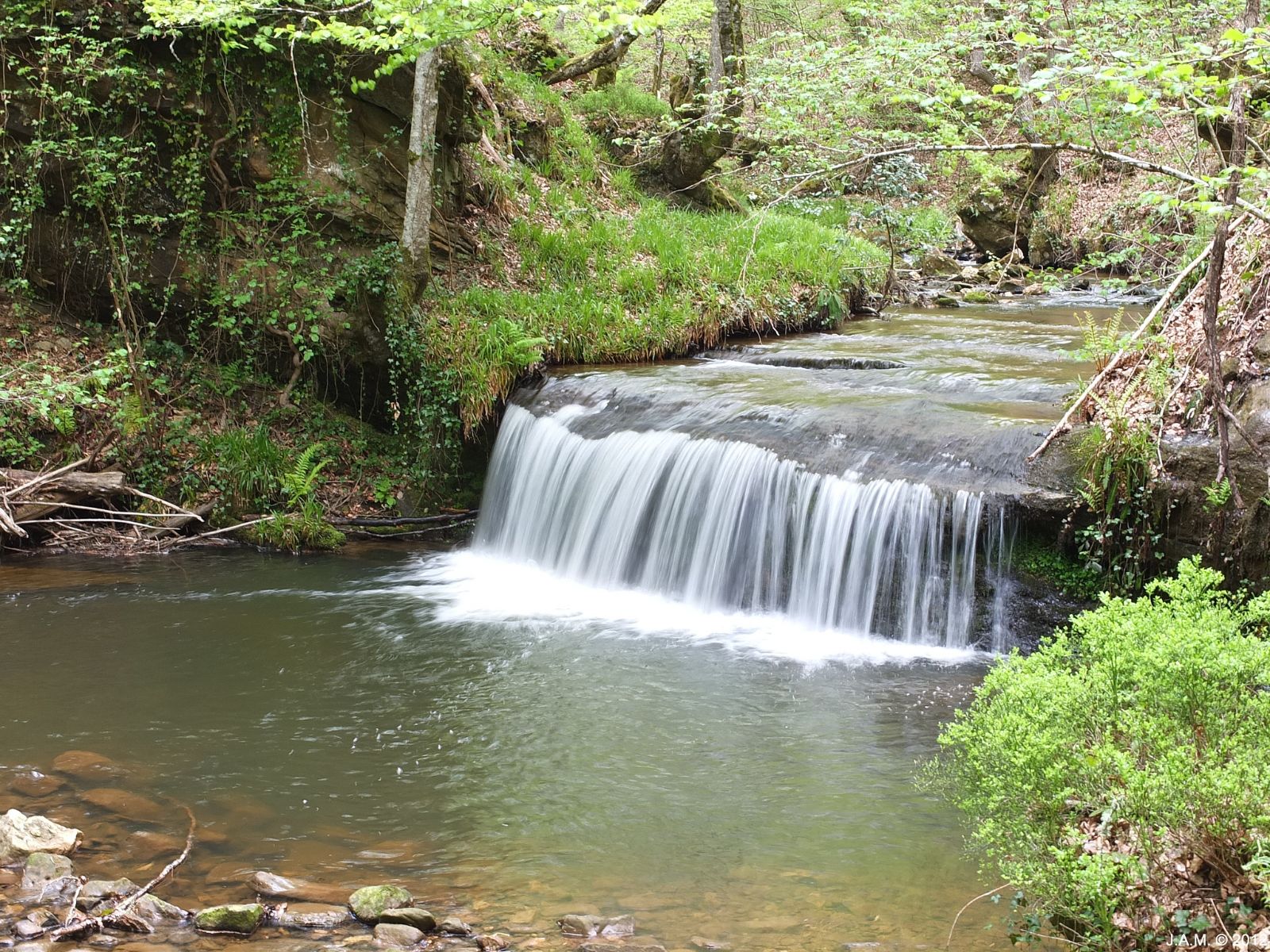
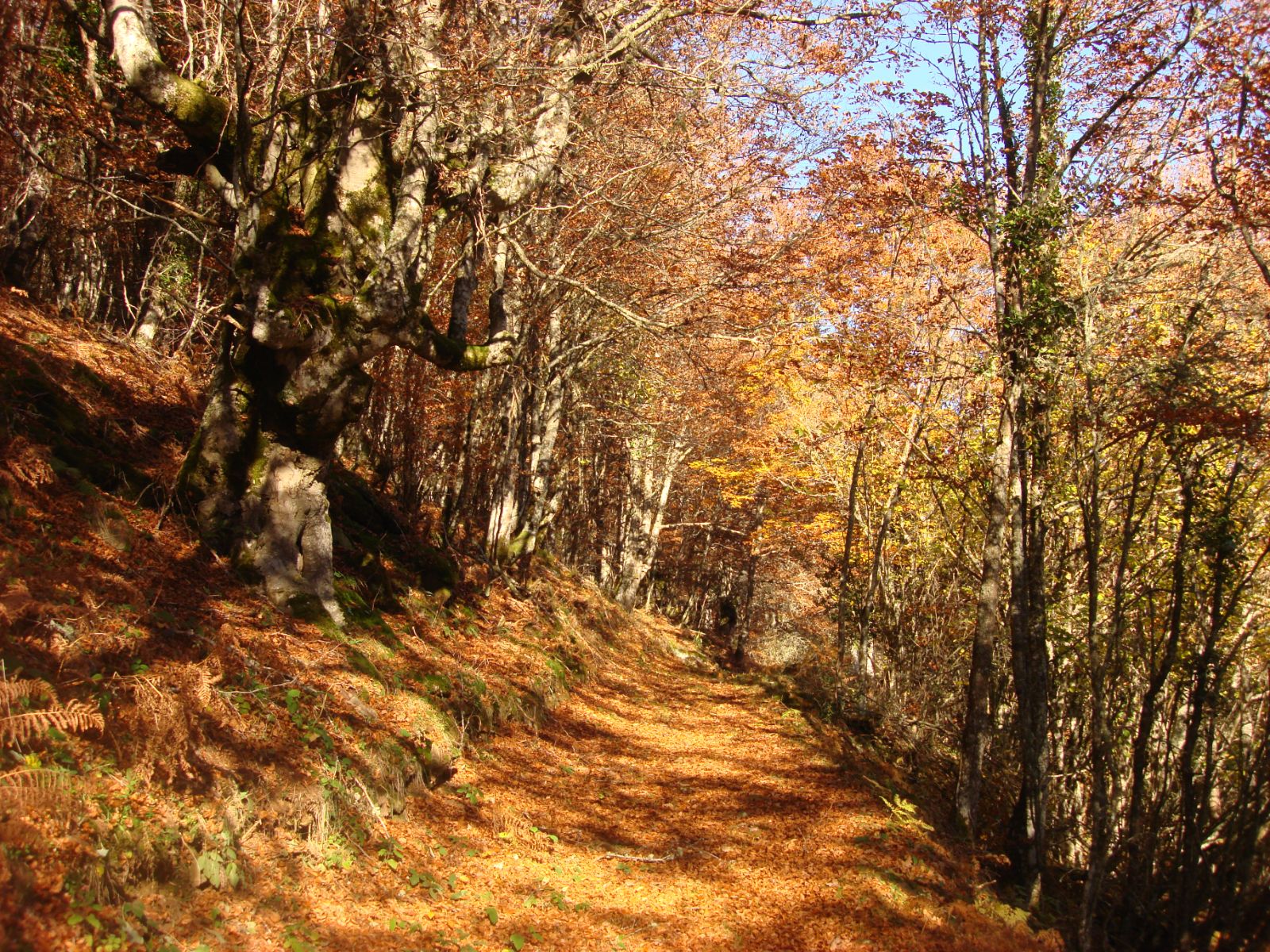
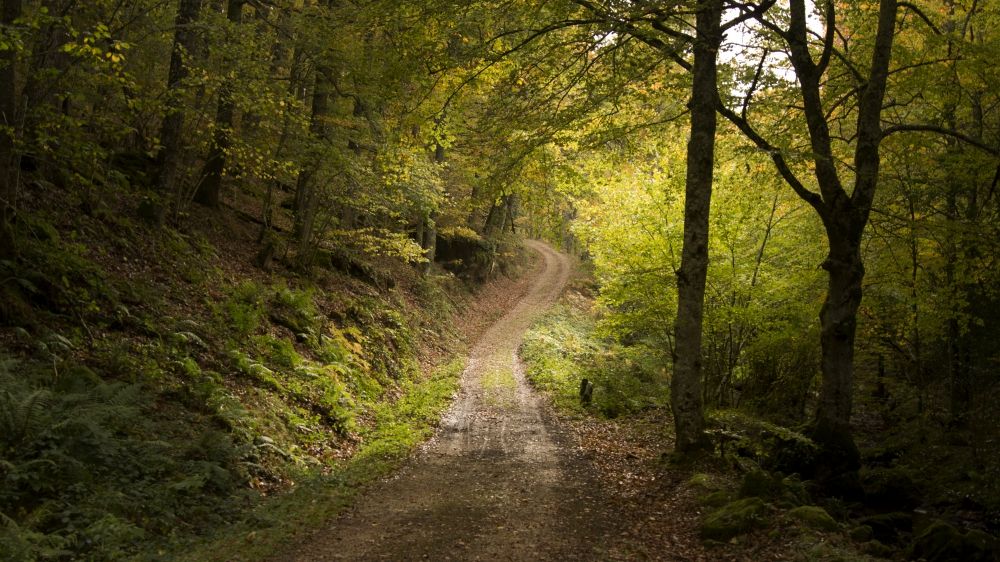
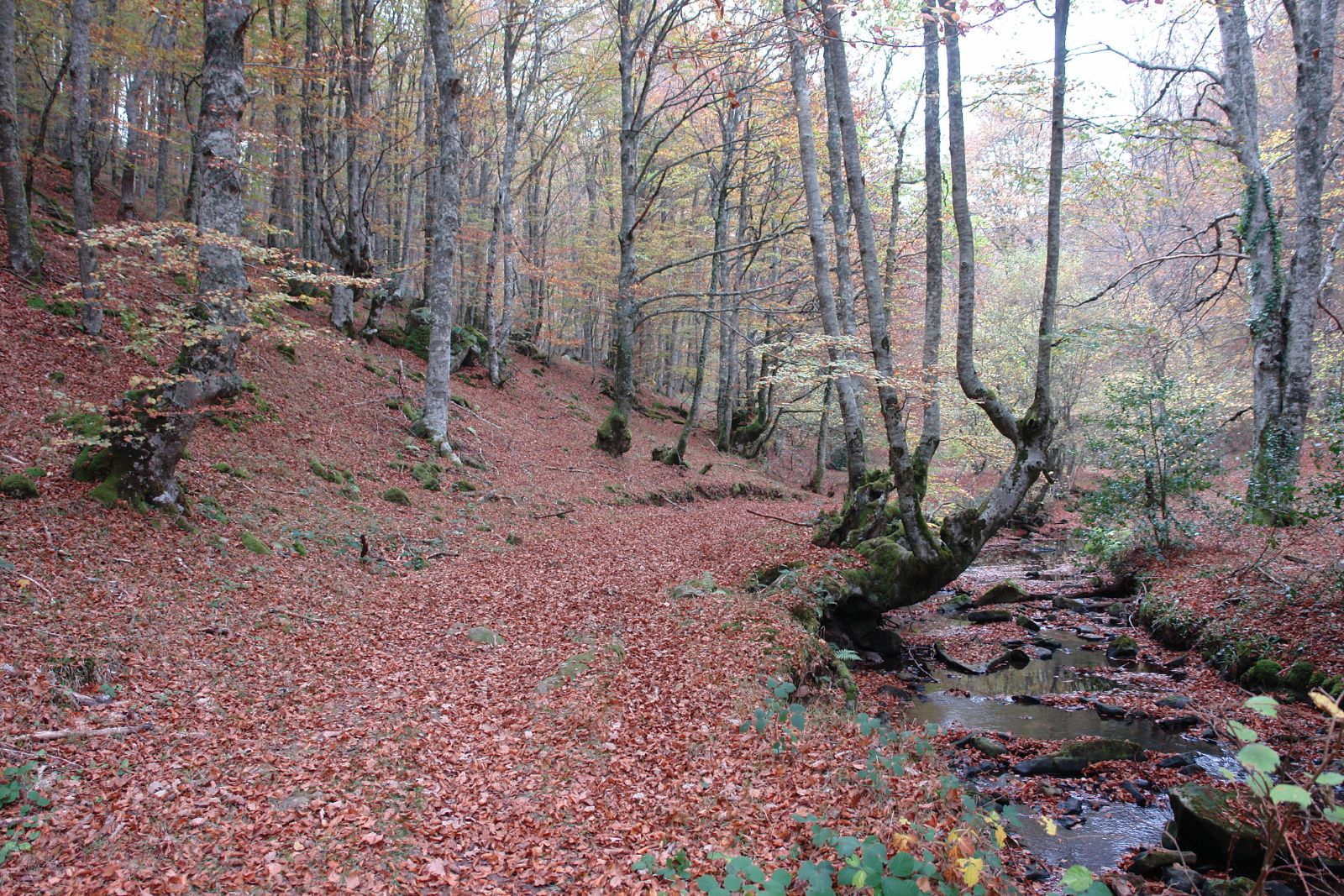
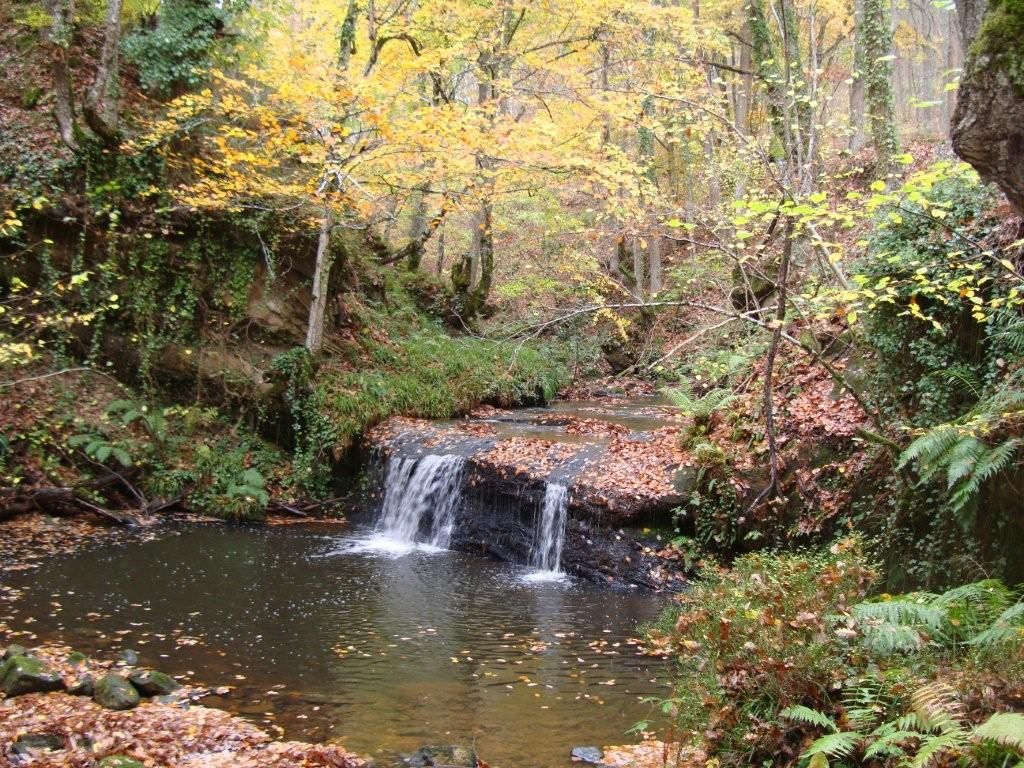
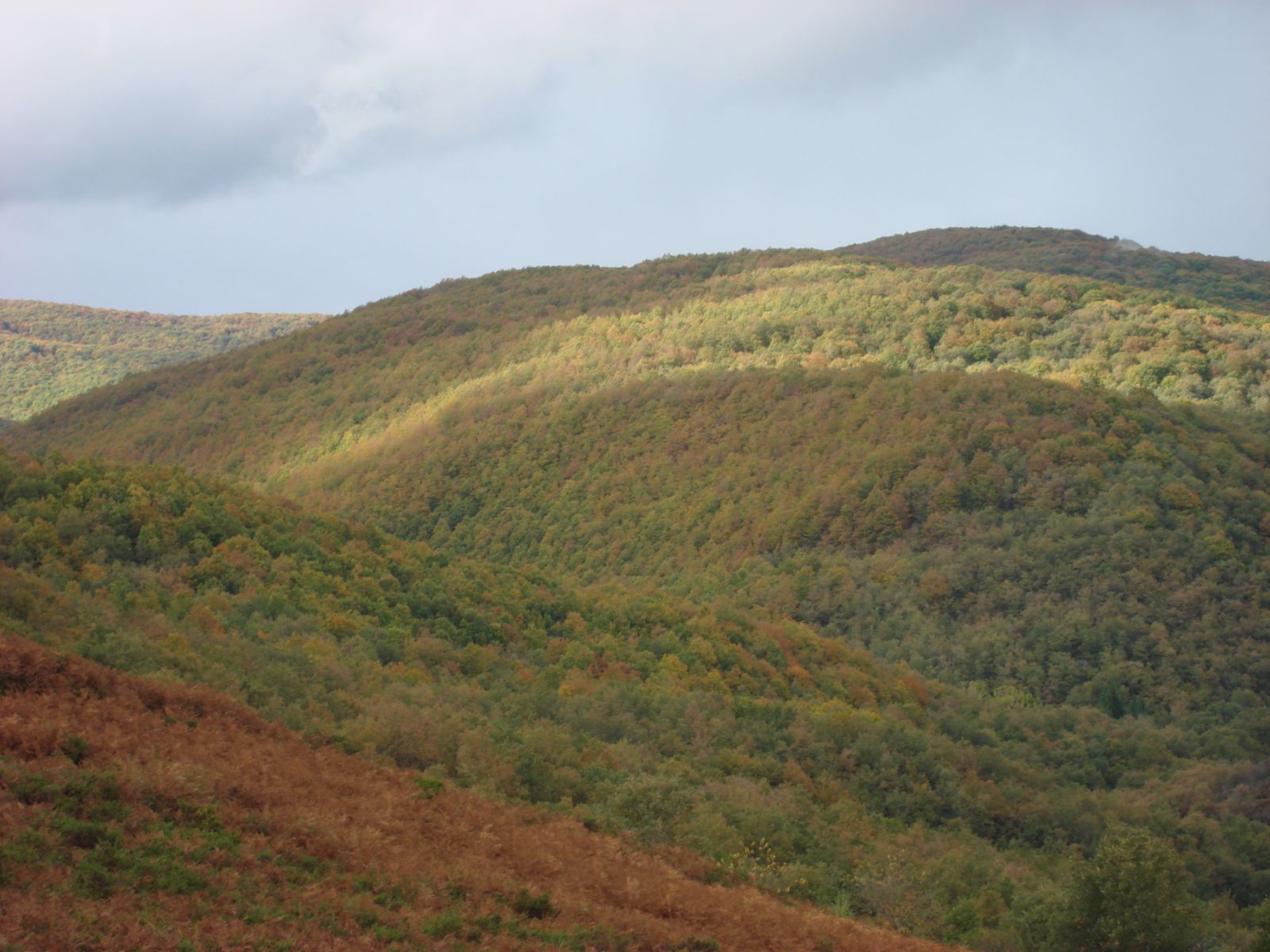
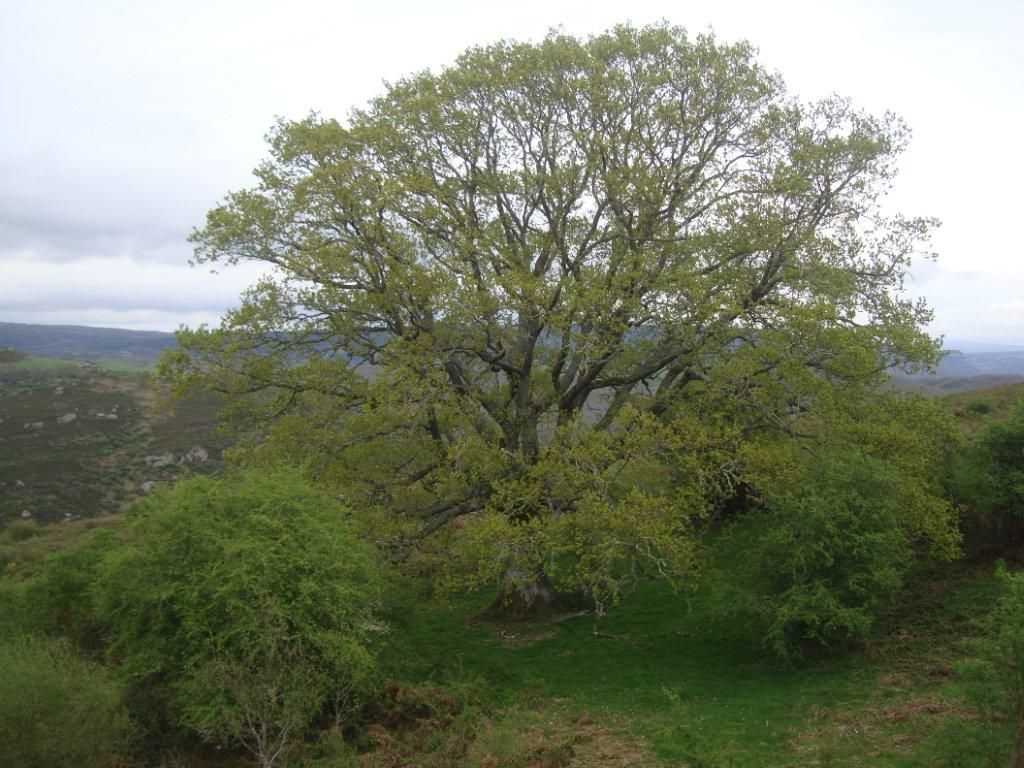
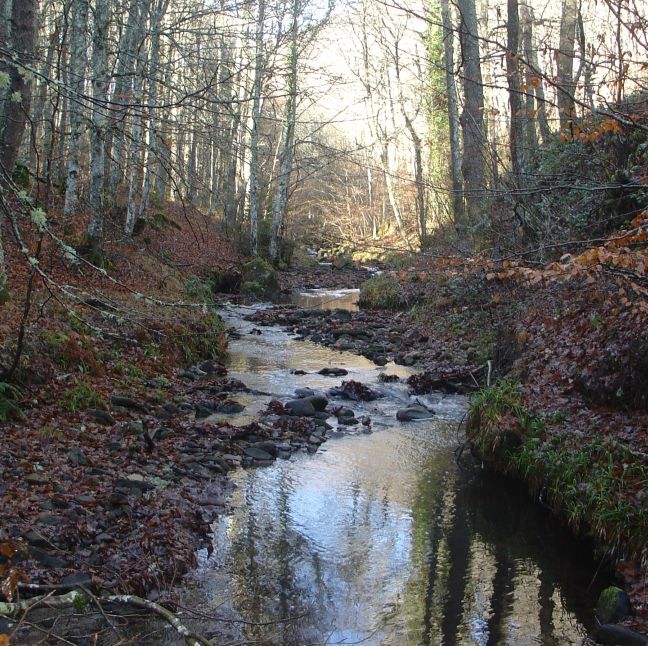
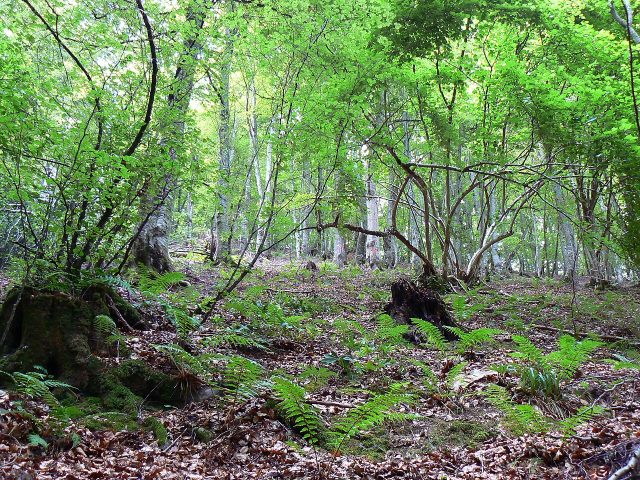
1,500 haof sessile oak and beech forest in Monte Hijedo
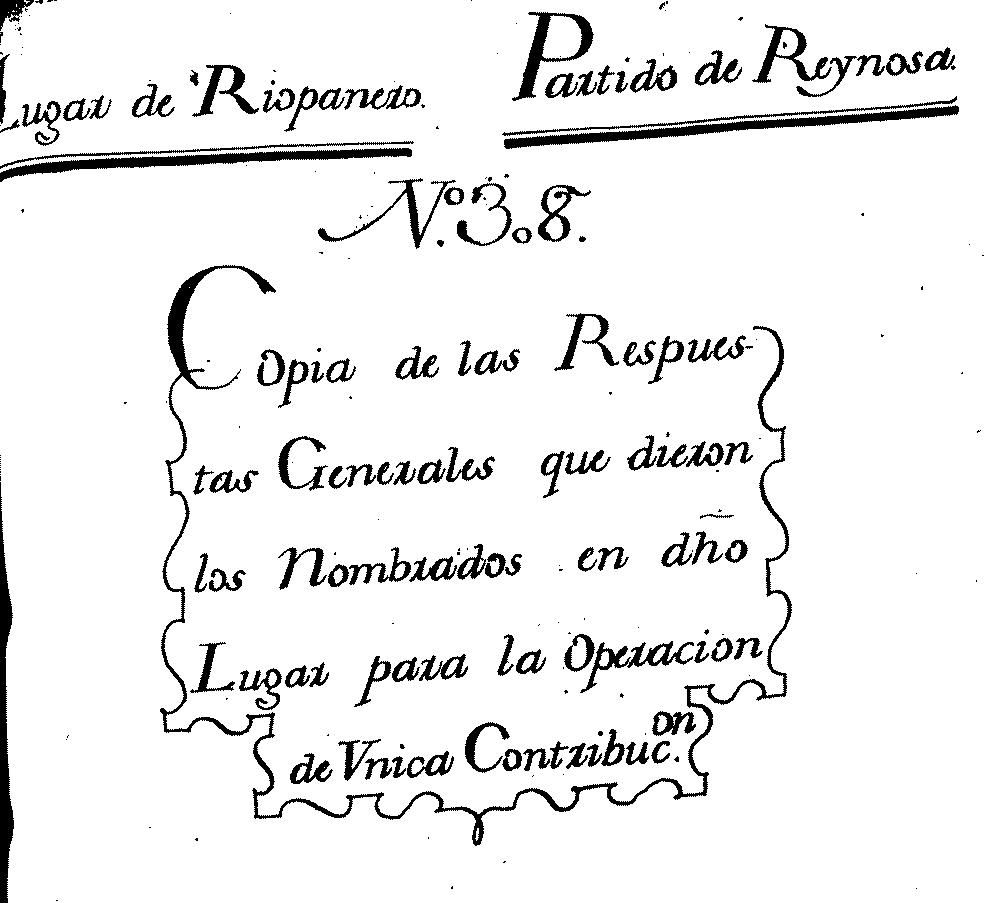
1583Riopanero by-laws, revised until 1830
Accessibility
Listen to this website
An audio version of the whole page, with descriptions of its images, for anyone who cannot or would rather not read it. The audio is in Spanish. Scan the code with your phone camera to listen or download it.
From Count Don Gonzalo's donation in 1185 to Madoz's Dictionary, the documents tell how the village has lived and governed itself.
The first historical record of Riopanero dates from 1185: a document by Bishop Marino, kept in the Historical Archive of Burgos Cathedral, records how Count Don Gonzalo gave the church of Burgos all his estate in Ruerrero and Riopanero.
In El Gobierno y la Administración de los Pueblos de Cantabria, professors Juan Baró Pazos and Rogelio Pérez-Bustamante collect the legal codes that governed village life:
The Riopanero by-laws of 1583, which revised earlier ones of unknown date, with chapters added and revised in 1636, 1753, 1822 and 1830.
The Monte Higedo by-laws1 of 1555, revised in 1574, 1714 and 1779.
In 1752, under King Ferdinand VI, the first modern land survey of the Crown of Castile was carried out: the Catastro de Ensenada. The entry for Riopanero begins (in translation):
“In the place of Riopanero, on the thirty-first day of October, seventeen hundred and fifty-two, His Worship Don Pedro José de Lanuza y Sotelo, Deputy of His Majesty and of the lords of his Royal Board of the Single Tax, called together Don Pedro Rodríguez Bustamante, parish priest of the church of Santa María in this same place, Juan Marlasca and Ventura Antonio Gómez, its aldermen, and Don Sebastián Rodríguez and Miguel Gómez, all residents and farmers of this place…”Catastro de Ensenada, Riopanero, 31 October 1752
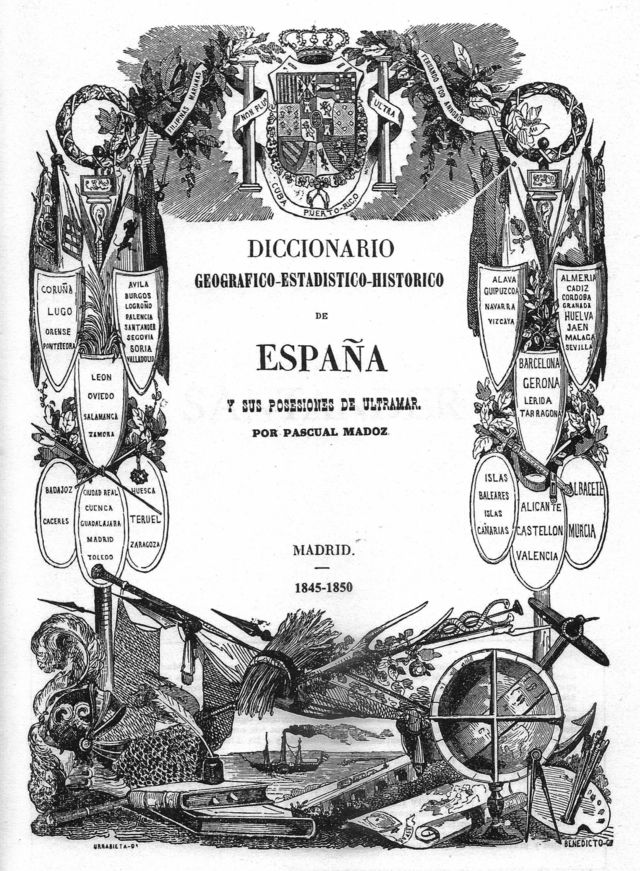
In 1845, Pascual Madoz's Geographical, Statistical and Historical Dictionary describes two nearby abandoned settlements, Punderio and La Corva, two flour mills and trades such as charcoal burning. Riopanero then had 28 houses, a church, the hermitage of San Román, 28 households and 120 inhabitants.
1 Originally written “Igetto”, “Igedo” or “Higedo”. According to José Luis Gutiérrez Cebrecos in his Toponimia campurriana, it may mean “place of shoots” or “young forest”.
For more information about Riopanero or these documents, write to us at info@riopanero.es.
Catastro de Ensenada (1752)Madoz's Dictionary (1845)
A unique forest
Monte Hijedo
Over 1,500 hectares of deciduous forest, with oak and beech woods, holly and yew, and a great wealth of plants and wildlife.
One of the great oak forests of Cantabria, shared with Alfoz de Santa Gadea (Burgos) and crossed from north to south by the Hijedo stream.
Riopanero sits on a hillside where the Hijedo stream joins the river Panero. It is the natural gateway to Monte Hijedo, a mainly deciduous forest of some 1,500 hectares of sessile oak and beech.
In Cantabria en la transición al Medievo, Joaquín González Echegaray identifies Monte Hijedo as the “mons Iggeto”, near the source of the Ebro, mentioned in a 10th-century gloss on the work of Saint Millán in Cantabria.
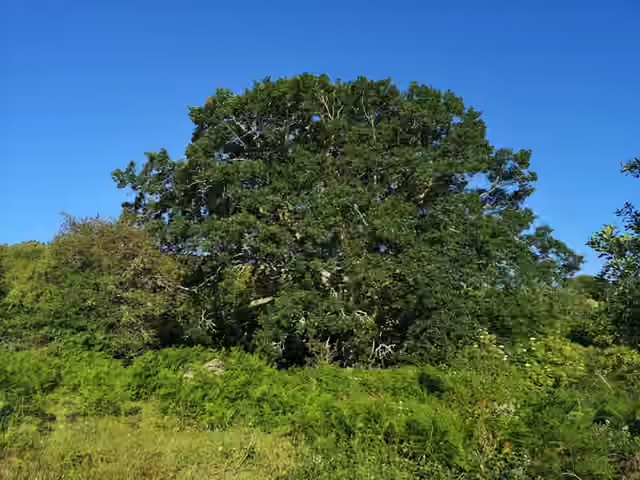
The forest is crossed by the Ebro Nature Trail (Camino Natural del Ebro), which on the Burgos side links up with the PR BU-30 footpath: a superb place for walking, mountain biking and horse riding. Next to the village are the Riopanero alder wood, a remarkable riverside forest, and a magnificent oak whose crown is more than 35 metres across: the Roble del Roturo.
The Roble del Roturo oak, Riopanero.
Before heading into the forest, a visit to the Monte Hijedo Visitor Centre is highly recommended.
01Trees and plants9 species
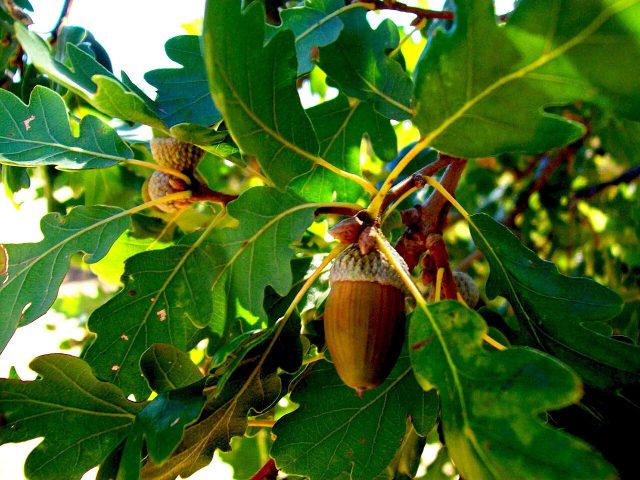
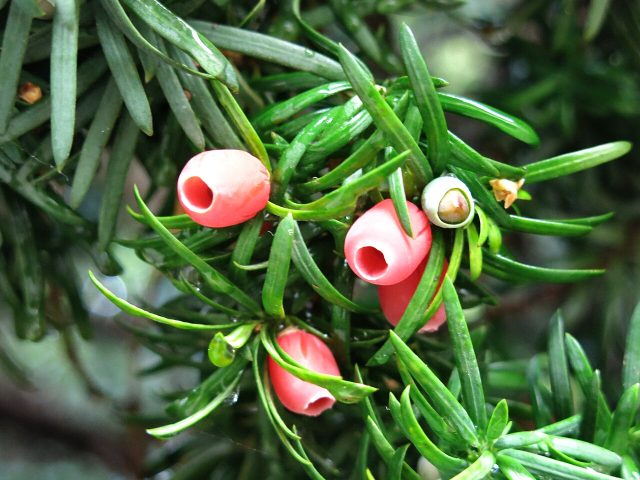
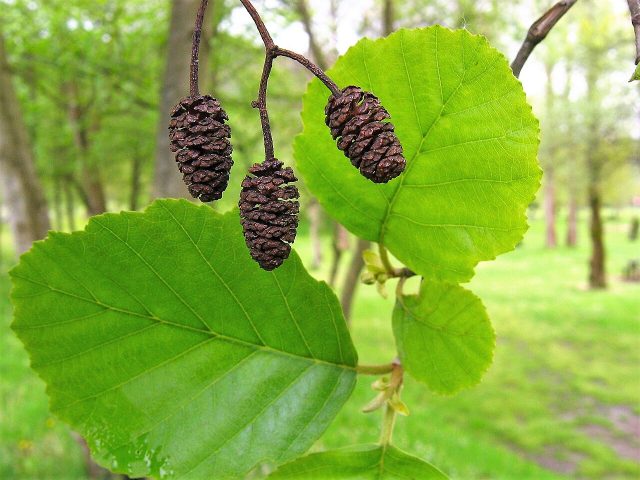
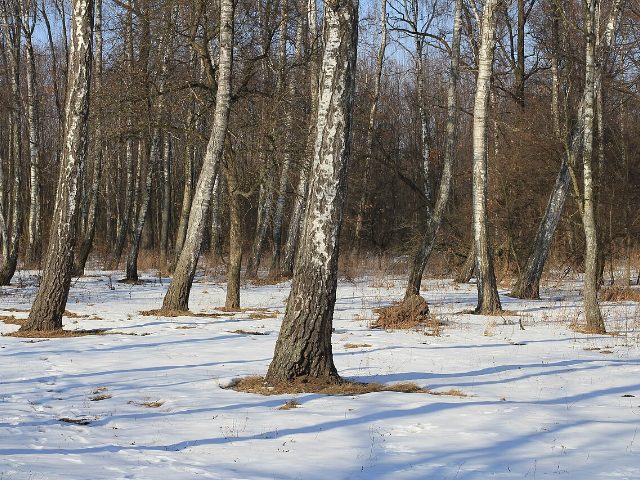
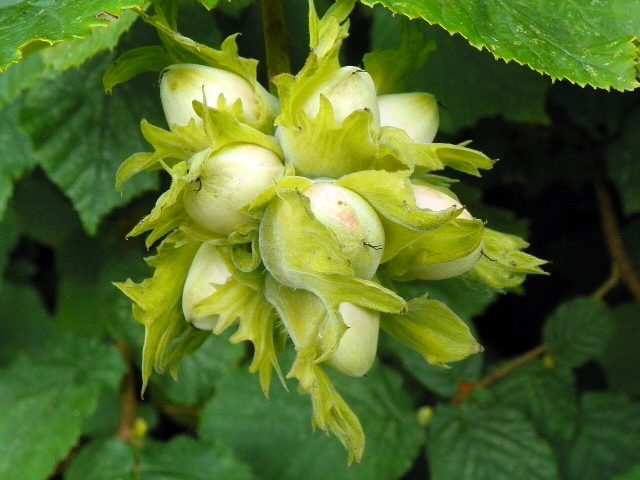
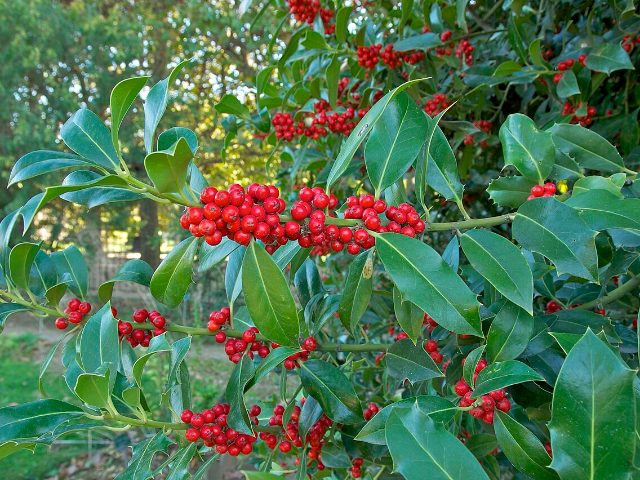
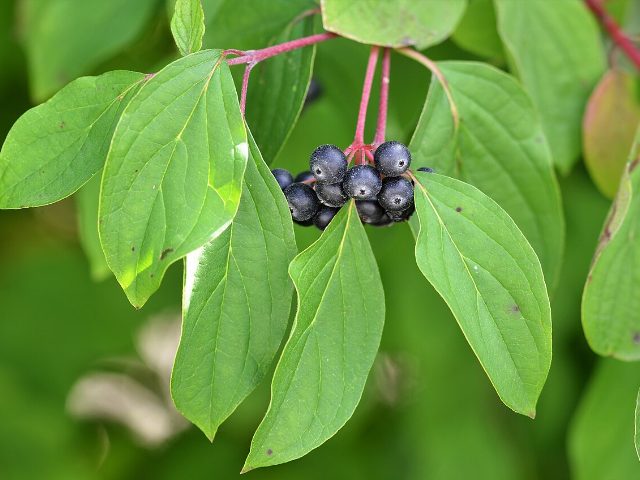
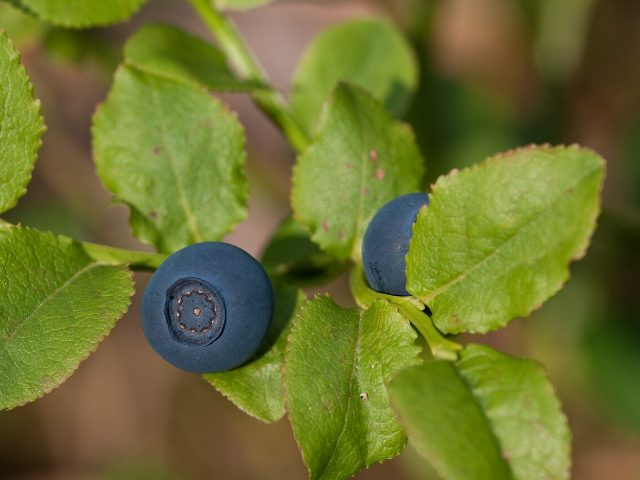
Sessile oaks and beeches make up the forest; yew, holly, birch, alder and hazel grow in its clearings and along its edges.
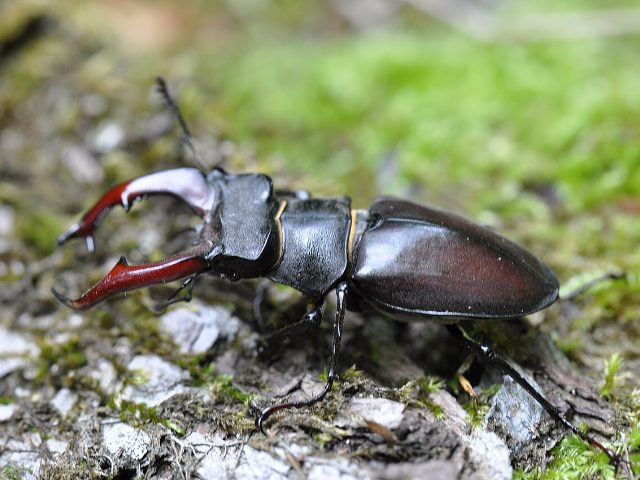
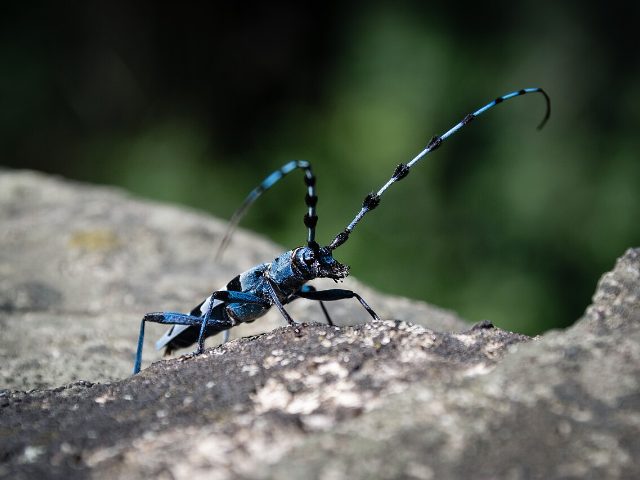
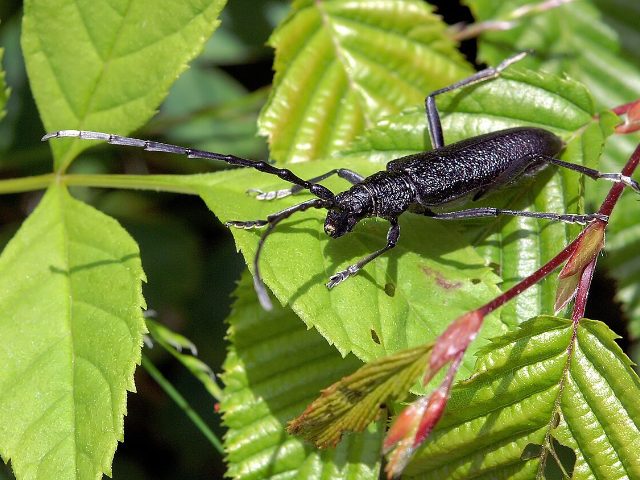
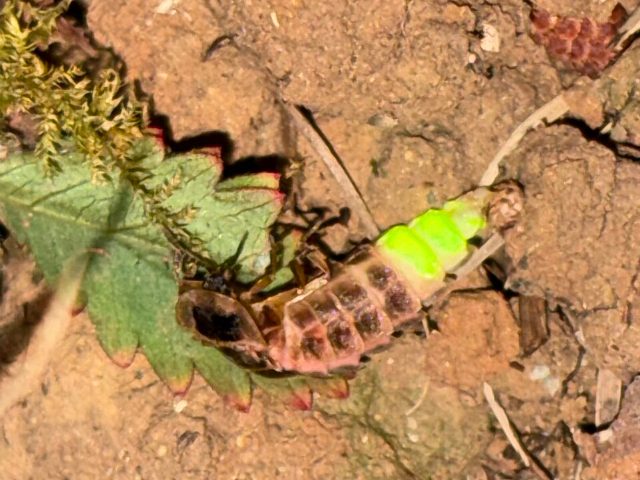
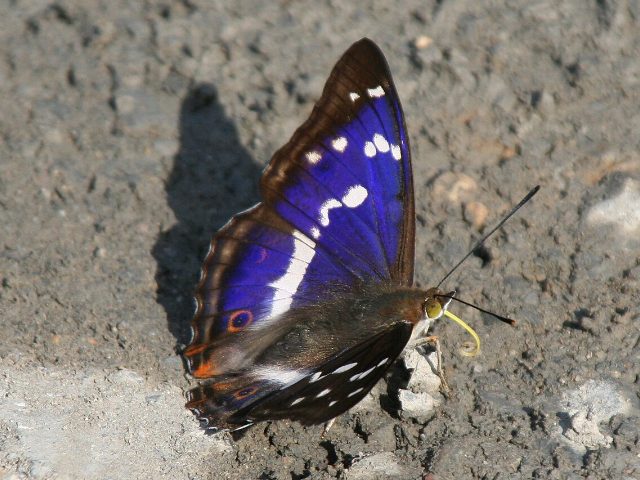
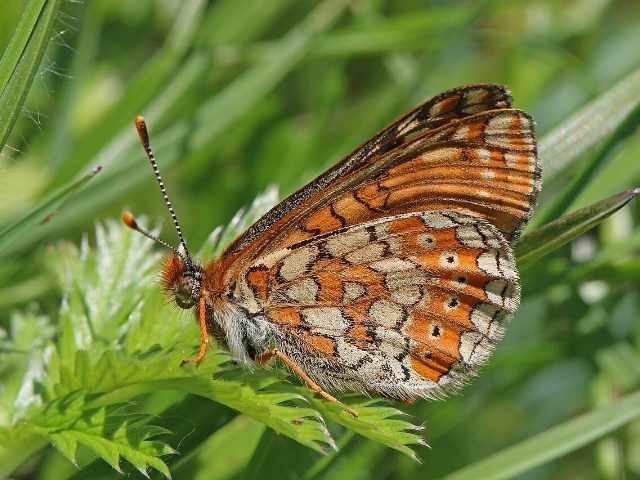
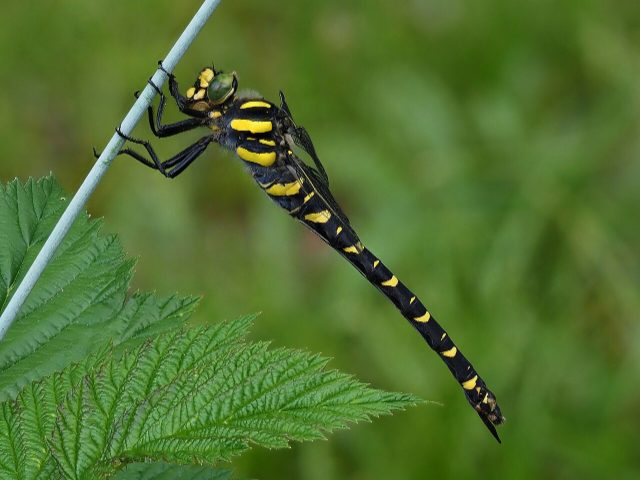
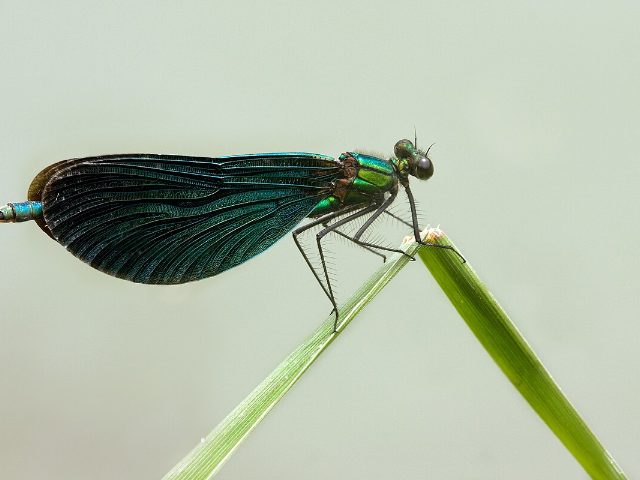
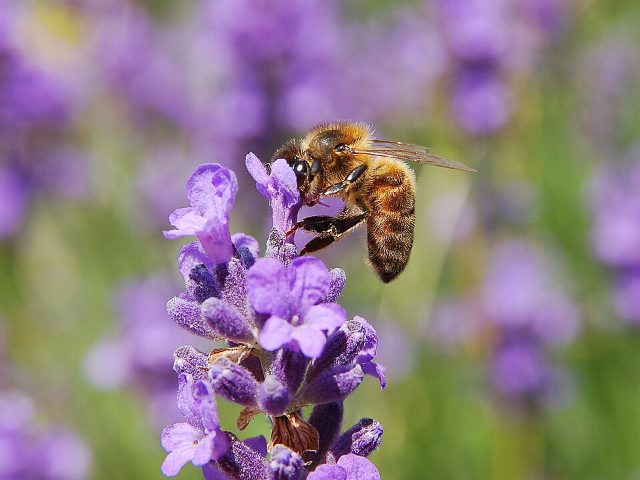
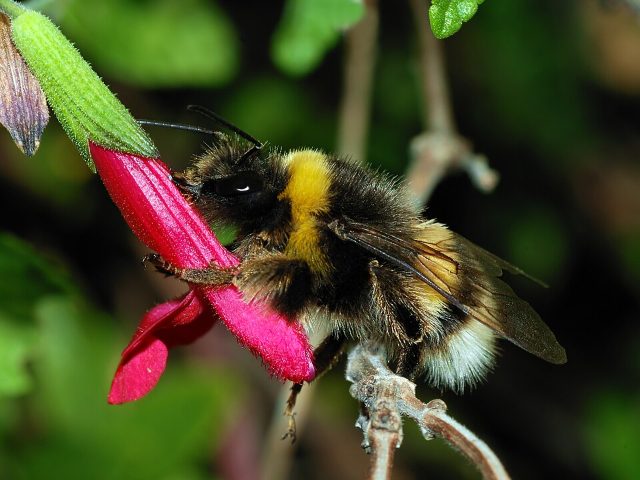
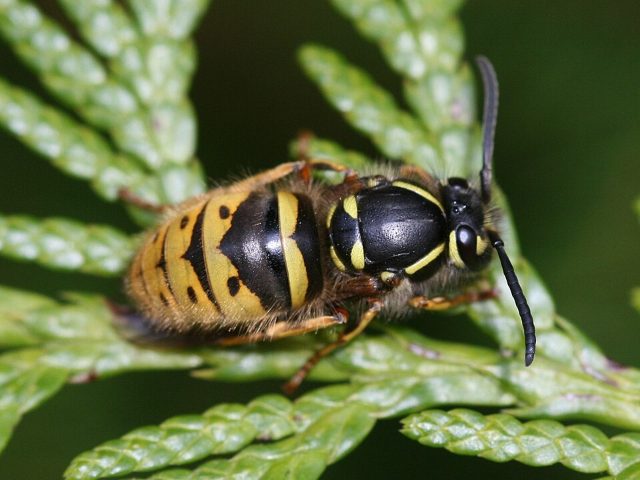
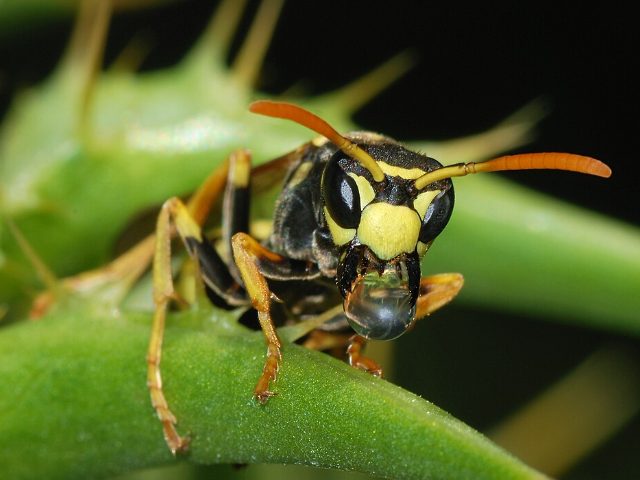
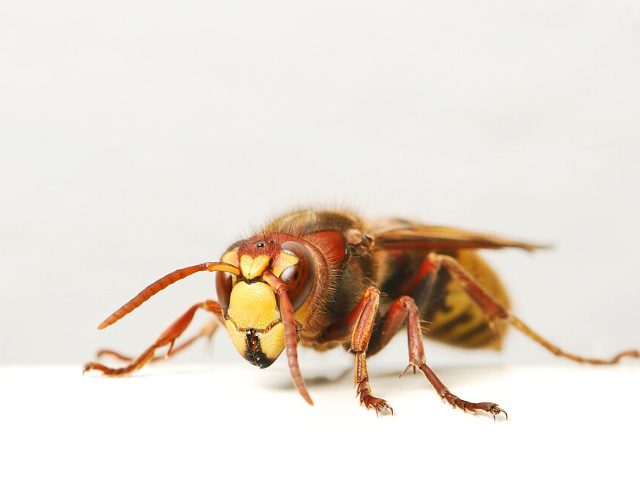
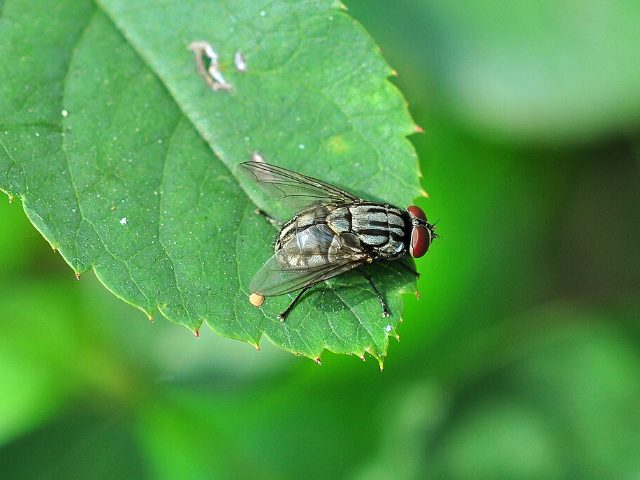
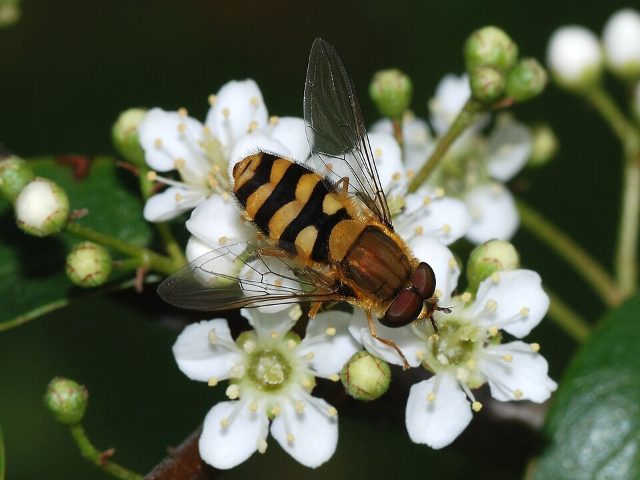
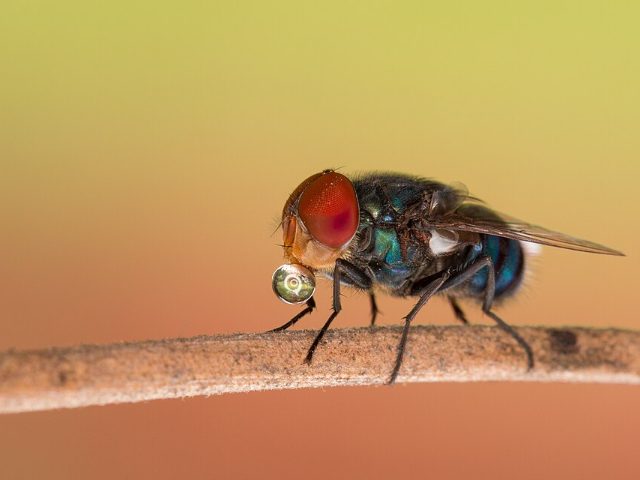
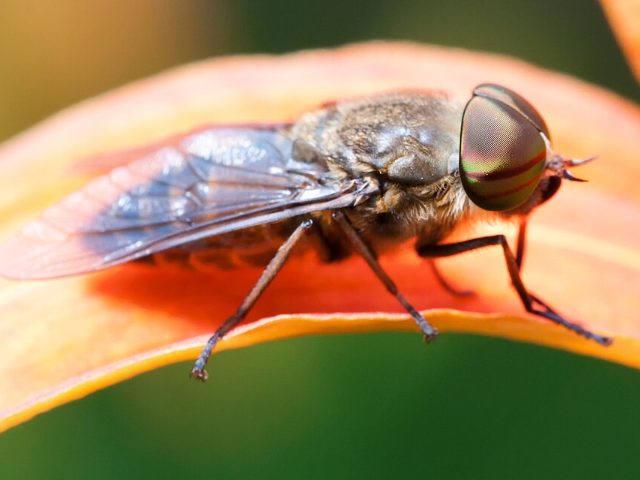
Insects typical of mature oak and beech forests like Monte Hijedo: beetles that live in old wood, woodland butterflies and stream dragonflies, together with bees, bumblebees, wasps, hornets, flies, blowflies and horse-flies.
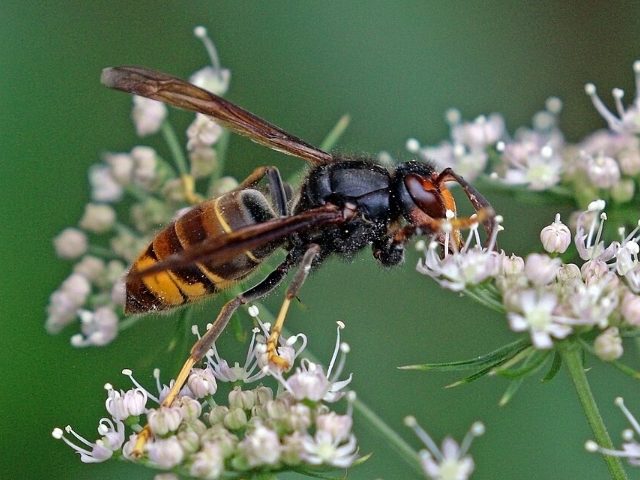
Warning · Asian hornet (Vespa velutina). This invasive species has spread across Cantabria and could appear in Monte Hijedo. It has an almost black body with a single orange band on the abdomen and yellow-tipped legs. If you see hornets or a nest, keep away and do not try to remove it: call 112.
Photo credits
Except for the bear, which is our own, the species photos come from Wikimedia Commons under the licence shown in each case (public domain, CC0, CC BY, CC BY-SA).
Asian hornet (possible presence): Charles J. Sharp (CC BY-SA 4.0, Wikimedia Commons)
Living with wildlife
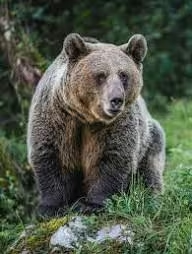
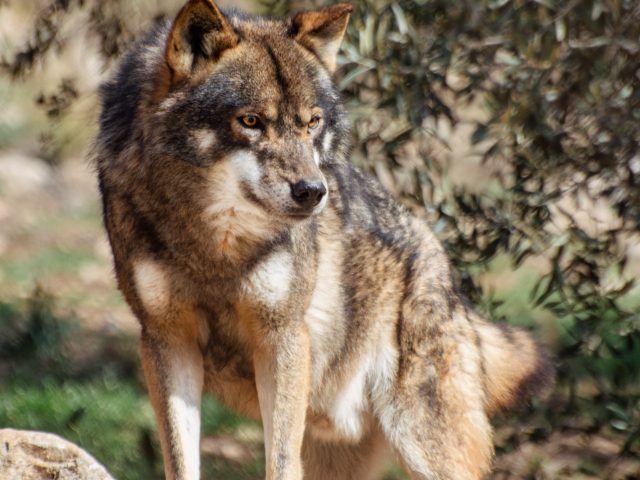
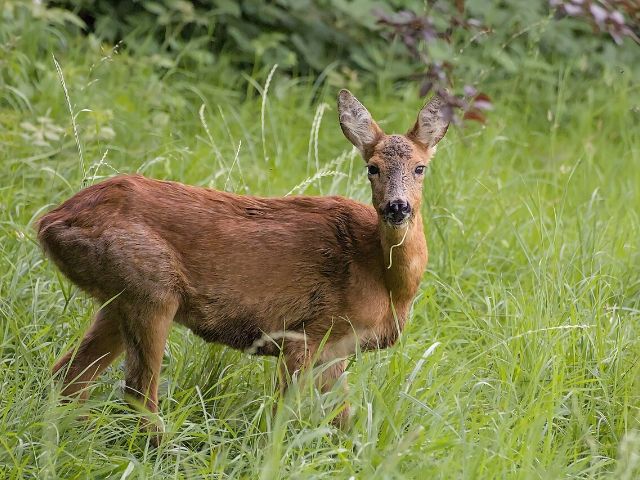
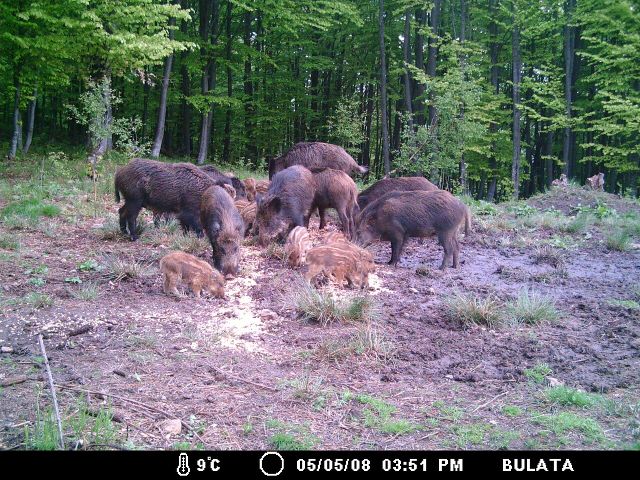
Roe deer, wild boar and wolves roam Monte Hijedo, and very occasionally a brown bear has been detected passing through. Seeing them is a privilege; letting them go about their lives undisturbed is the best gift we can give them.
What can you easily see?
A rough guide to what you may come across on a quiet walk through the forest and along its edges. Wildlife is free: nothing is guaranteed.
Almost certainSeen or heard on any walk
Woodland birdsnuthatch, tits, jay, green woodpecker
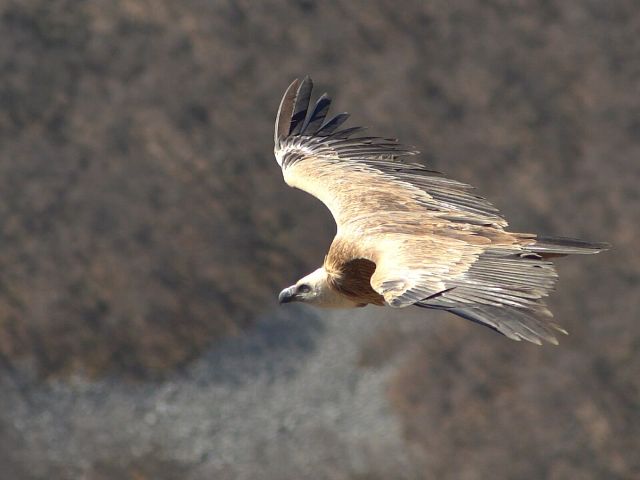
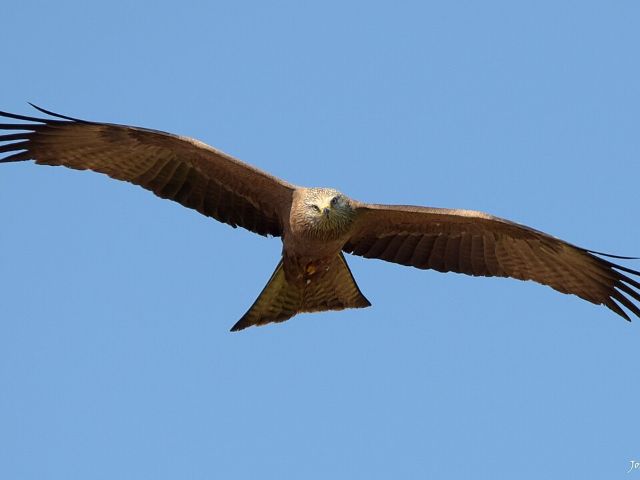
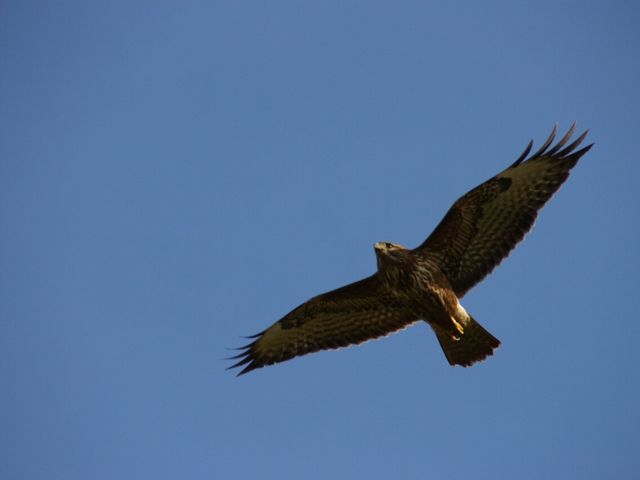
Raptors over the valleygriffon vulture, buzzard, red kite; in summer, black kite
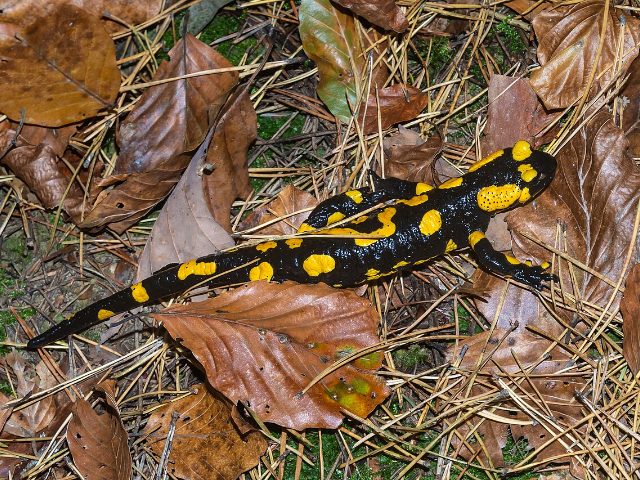
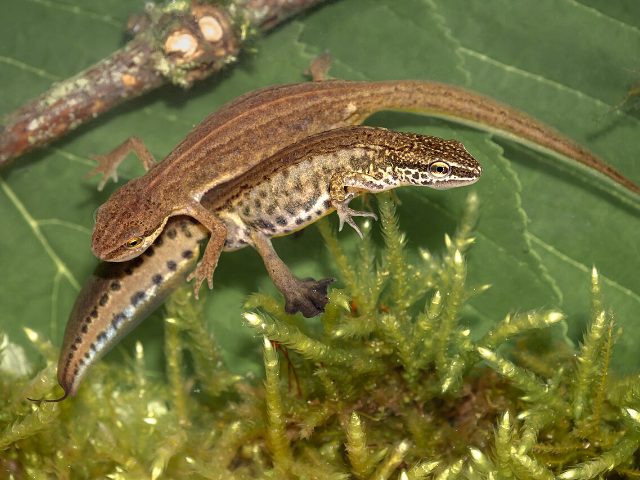
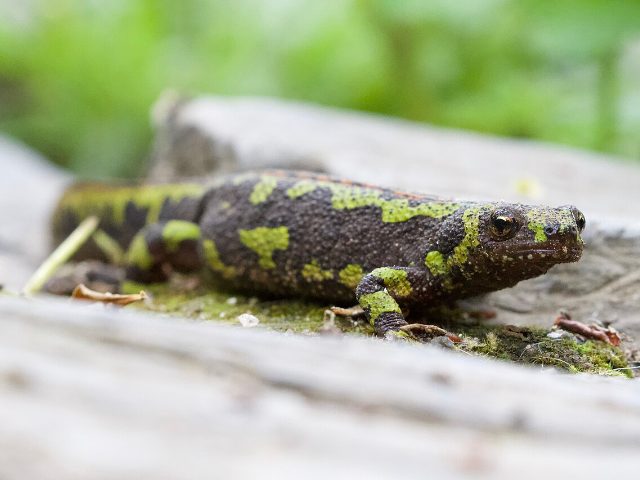
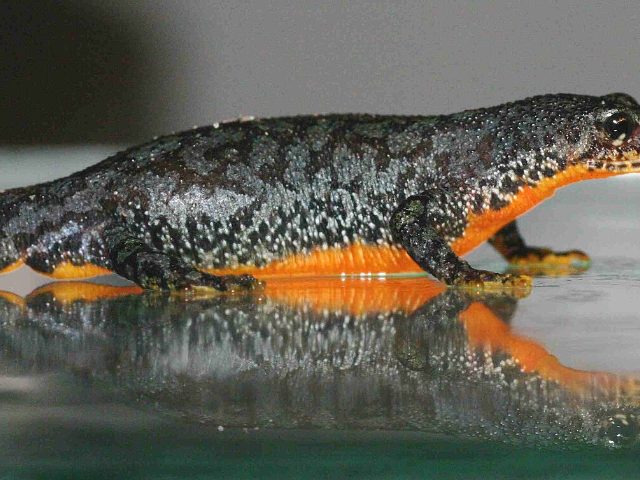
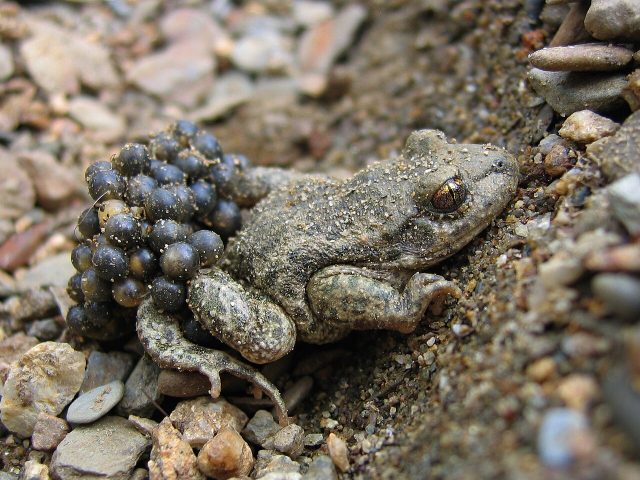
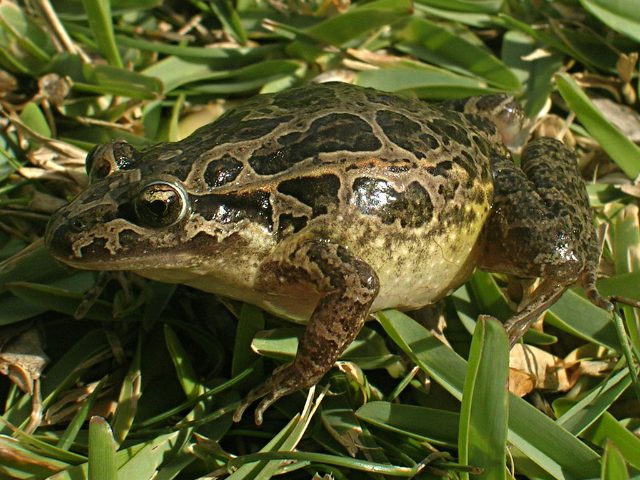
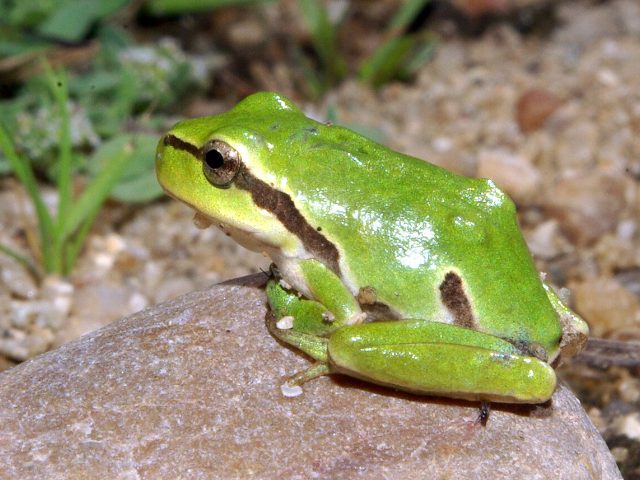
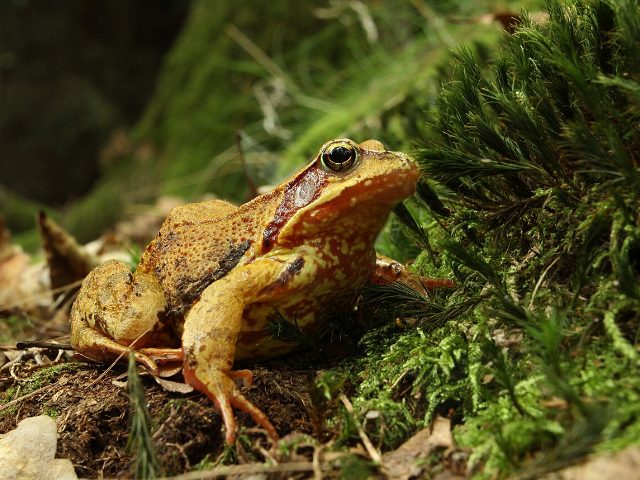
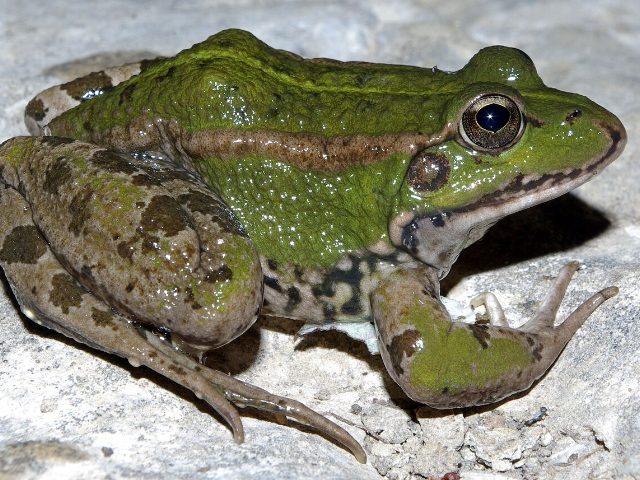
Amphibians in the streamsfrogs and newts; fire salamander on rainy days
Tracks and signsprints in the mud and ground turned over by wild boar
LikelyWith patience, at dawn or dusk
Roe deerin clearings and meadows by the forest; often heard “barking”
Black woodpeckerthe largest woodpecker: listen for its call and drumming in old oaks and beeches
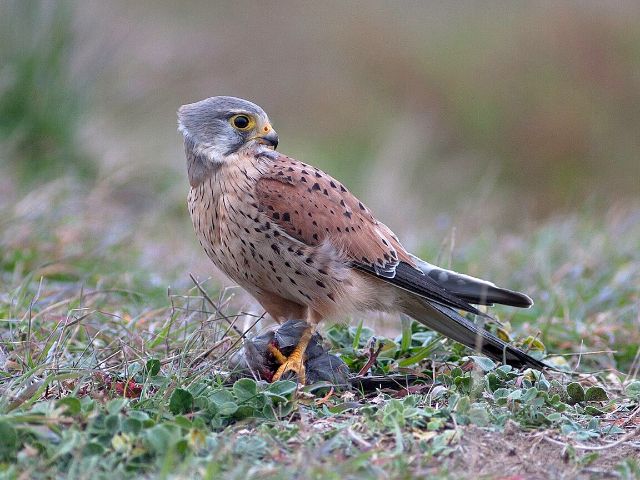
Goshawk, sparrowhawk and short-toed eaglethe eagle from spring to autumn
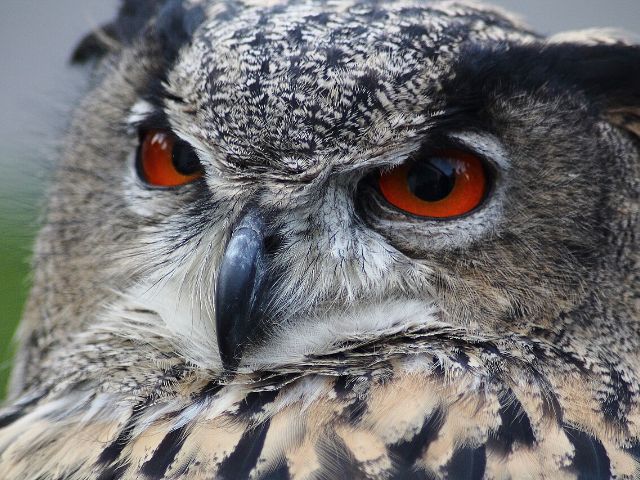
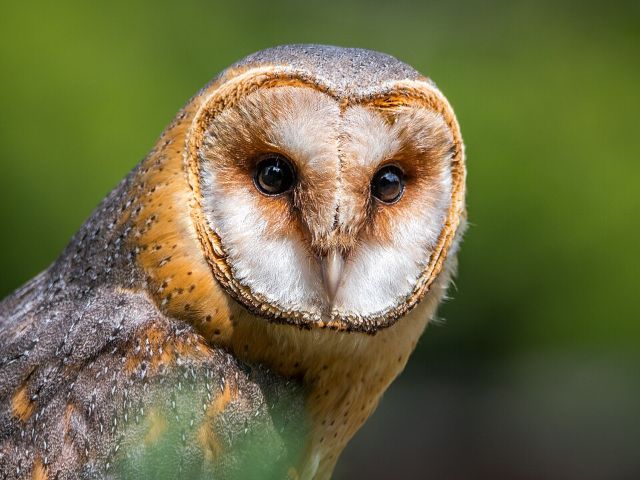
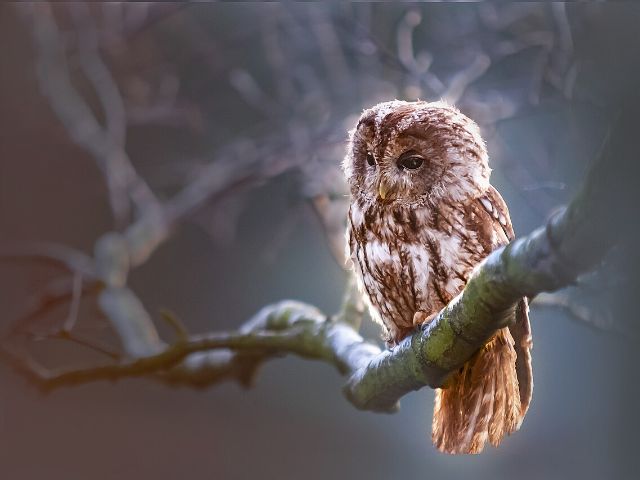
Tawny owlheard hooting at dusk, especially in autumn and winter
With luckShy or nocturnal animals
Wild boarmostly late in the day
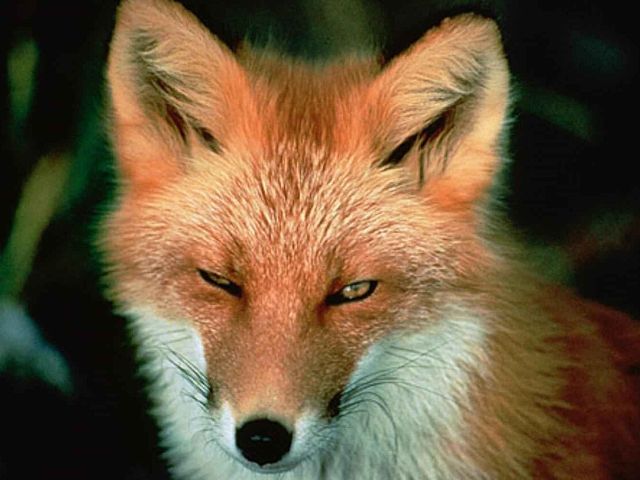
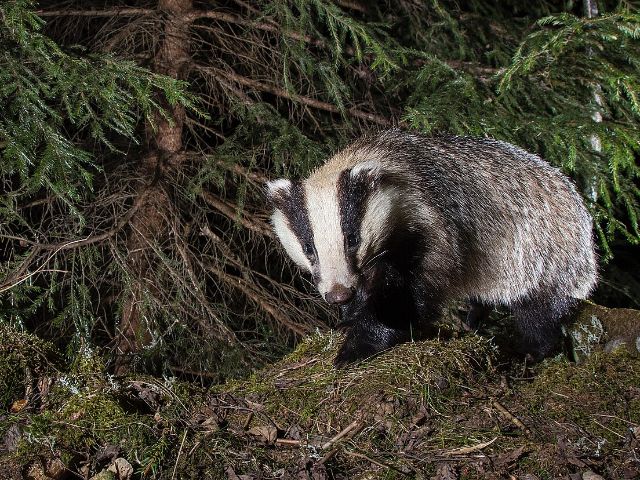
Fox and badgerat dusk, along the forest edge
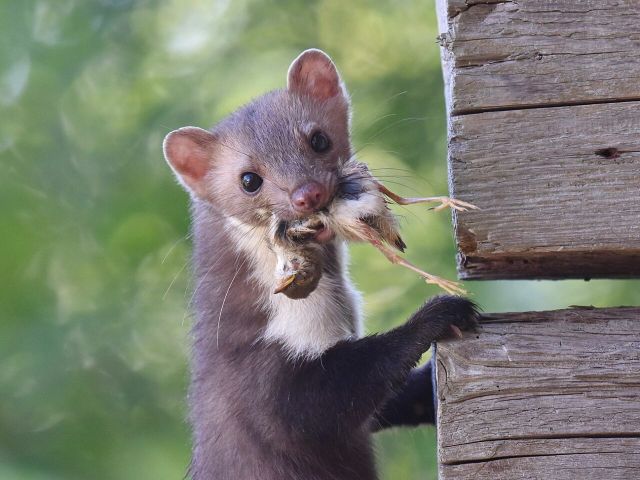
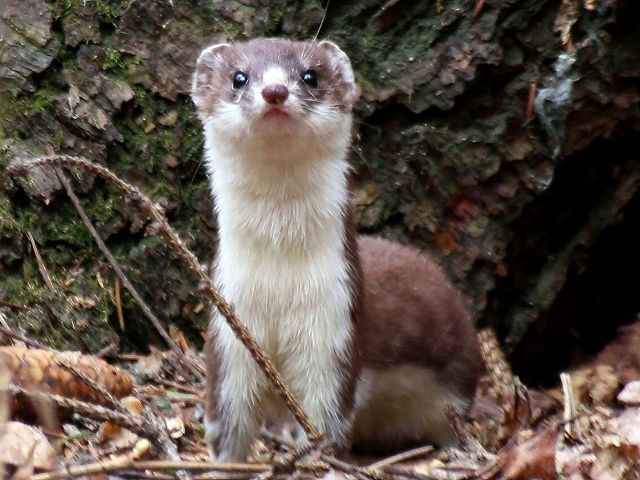
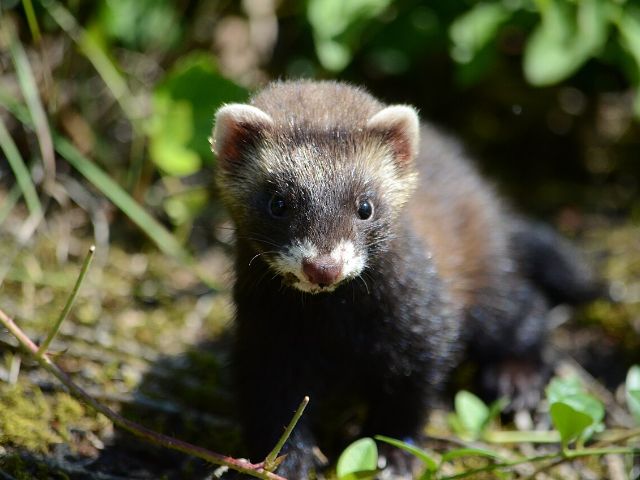
Pine marten, stone marten, stoat and wildcatelusive; their tracks and droppings are easier to find
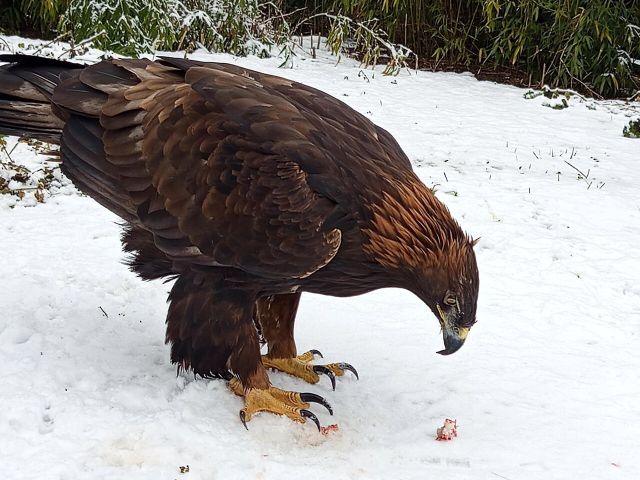
Golden eagleover the open ridges
ExceptionalA privilege very few people enjoy
Wolflives in the densest areas; sightings are very rare, although its signs can be found
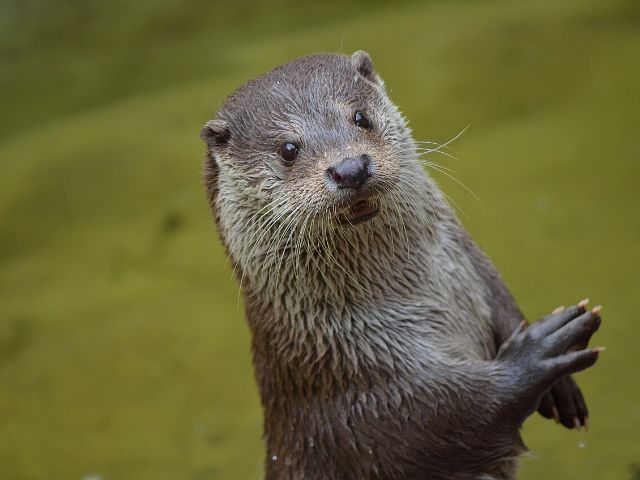
Otter and Pyrenean desmanin clean rivers; they give themselves away by their signs
Brown bearonly passing through, and very rarely
Where and when to look
Forest edges and meadowsRoe deer at dawn and dusk, and hunting raptors.
Old oaks and beechesWoodpeckers, nuthatches and tits.
Hijedo stream and pondsFrogs, newts and salamanders. Look, do not touch.
The sky over the valleyVultures, kites and buzzards riding midday thermals.
SpringThe forest sings: the best season for birds.
SummerMigrant raptors and lots of activity at dawn.
AutumnColours and a quiet forest; the tawny owl calls.
WinterWith bare branches birds are easier to see, and tracks show in mud and snow.
To see more: start early, bring binoculars, walk slowly and quietly, wear muted colours and stop for a few minutes at the edge of a clearing.
If you meet a large animal
Stop and stay calmDo not shout or make sudden movements. The animal will almost always leave on its own.
Give it space and a way outDo not approach or block its path. Never get between a mother and her young.
Back away slowlyDo not run or turn your back; leave the way you came.
How far away?
If the animal stops feeding, lifts its head or moves away because of you, you are too close.
CloseFar
Bear100 m or more
Wolf and wild boar50 m or more
Roe deer, birds and the restBinoculars and zoom
What to do with each one
Brown bearVery rare and elusive; an encounter is exceptional.
Do
Speak calmly so it knows you are a person.
Move away slowly, facing it.
Don’t
Approach it for a photo or follow its tracks.
Run or climb a tree.
Iberian wolfIt avoids people. Most visitors never see one.
Do
Make yourself look big and speak loudly if it stares.
Keep your dog on a lead and close to you.
Don’t
Chase it, corner it or feed it.
Leave food scraps in the forest.
Wild boarIt defends itself if cornered or with piglets.
Do
Always leave it an escape route.
Step off the path and let it pass.
Don’t
Approach a sow with piglets.
Feed it: it loses its fear and becomes dangerous.
Roe deer and fawnsIn spring mothers leave their fawn hidden and come back for it.
Do
Leave the fawn where it is: it has not been abandoned.
If you find an injured animal, call 112.
Don’t
Touch or pick it up: the mother may reject it.
Take it home “to save it”.
Guard dogs and livestockMastiffs protect the herds from wolves; they are doing their job.
Do
Walk calmly around the herd, at a distance.
On a bike, get off and walk past.
Don’t
Walk through the herd or separate calves.
Shout, threaten or raise a stick.
Your dogTo wildlife, a loose dog is a predator.
Do
Always keep it on a lead in the forest.
Pick up after it.
Don’t
Let it chase deer, birds or livestock.
Let it off the lead in the breeding season (spring).
Golden rules
Do not feedAny wild animal.
Keep quietNo music or shouting.
Dogs on a leadAlways, everywhere in the forest.
Do not touch young or nestsLook, then leave them be.
Photos without disturbanceUse zoom, no flash, no lures or bait.
Drive slowlyEspecially at dawn and dusk.
When they are most active
DawnMiddayDuskNight
Wildlife moves most at dawn and dusk: the best time to watch quietly, and the riskiest for collisions on the road.
Seen an injured, poisoned or distressed animal, or a bear or wolf near the village? Call 112, who will alert the environmental rangers. Do not touch it.
The essentials for enjoying Monte Hijedo safely, at a glance.
Before you set out
Check the weatherFog, rain and cold come in quickly, even in summer.
No coverageDownload the route or map to your phone before you go.
Tell someoneSay which route you are taking and when you expect to be back.
GearWalking boots, warm and waterproof layers, water and food: there are no springs or facilities.
Start earlyIn autumn and winter it gets dark early, and even earlier under the trees.
In the forest
Stay on the pathsKeep to marked tracks and footpaths.
No firesFires are forbidden. Do not smoke in the forest.
Take your rubbishAll of it, including food scraps.
Close the gatesLeave them as you find them.
Take nothing awayNo plants or branches, and leave dead wood: it is home to protected insects. Mushrooms only in moderation, following the guide (Spanish).
Quiet and distanceWatch wildlife from afar and do not feed it.
Where are you?Route, last known point and, if you can, your phone's coordinates.
Stay reachableDo not hang up until told to, and do not move unless necessary.
No signal? Move to open ground and try again: a text message sometimes gets through when a call does not.
Risks worth knowing about
Free-roaming cattleKeep away from cows with calves and never come between them. Dogs on a lead.
HuntingIn season there may be organised hunts, marked with signs. Respect the warnings and wear something bright.
TicksWear long trousers and check skin and clothes when you get back.
VipersRare and shy. Watch where you step and put your hands. If bitten: keep still and call 112.
Asian hornetIf you see hornets or a nest, keep away and call 112.
The forest through the year
SpringCows with calves · ticks · muddy paths
SummerHeat and fire risk · horse-flies · ticks
AutumnMushrooms · hunting season · early dusk
WinterFog, ice and snow · hunting · short days
Heritage
Stone, timber and memory
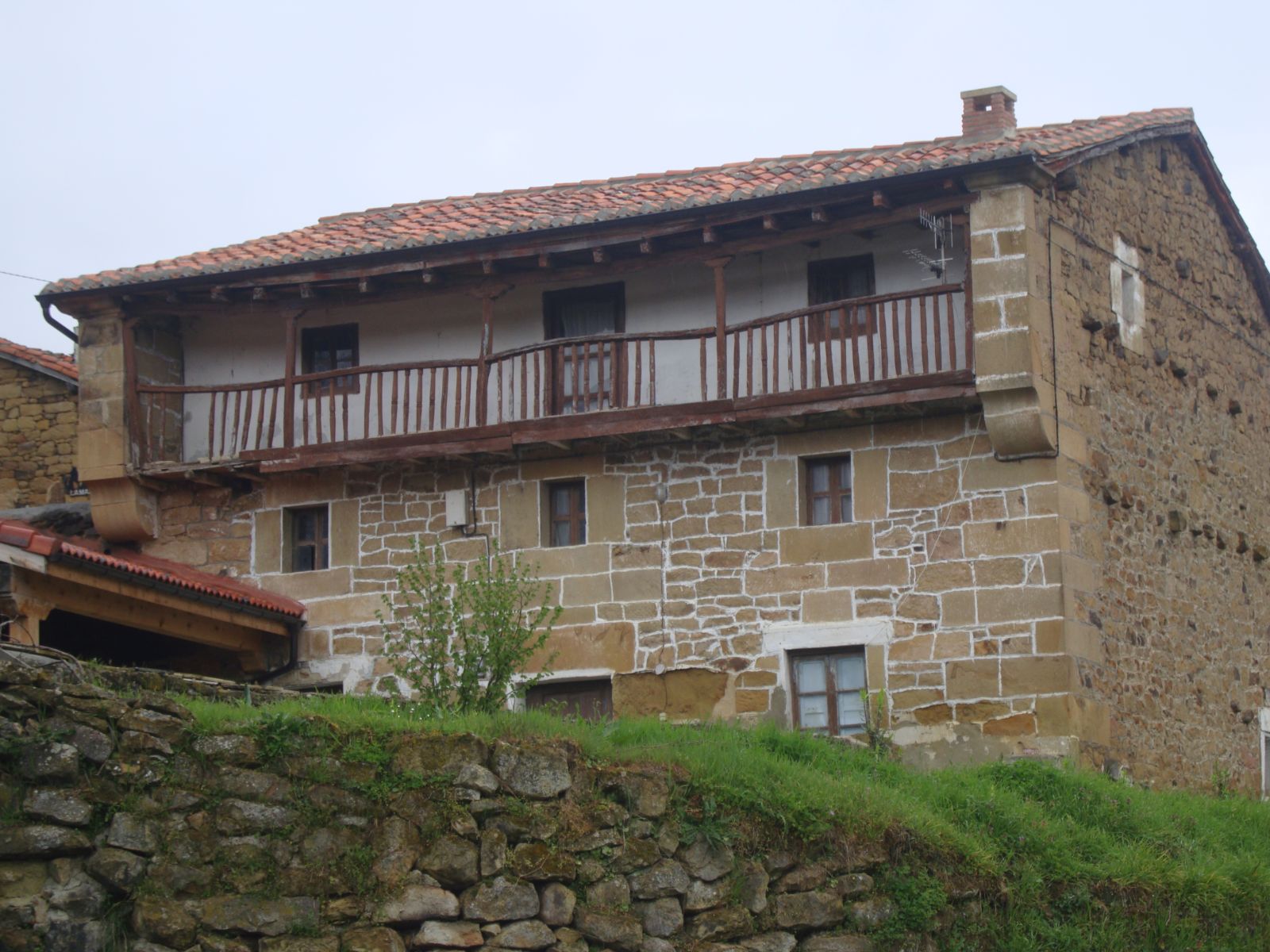
Traditional houses, a tower house, the old school, the mill and the Church of the Immaculate Conception.
Church of the Immaculate Conception
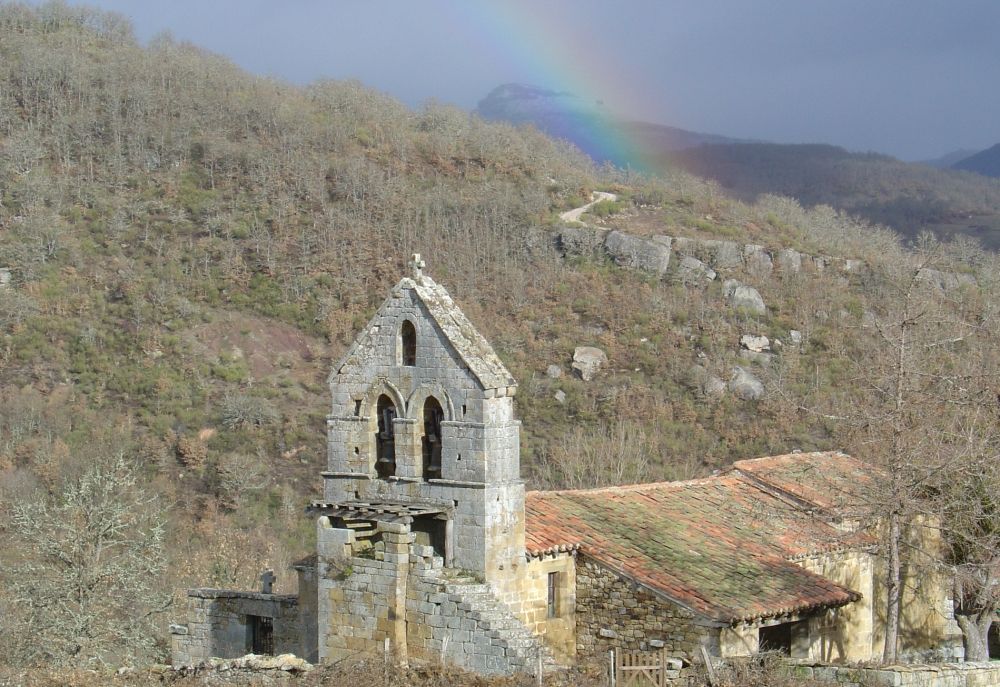
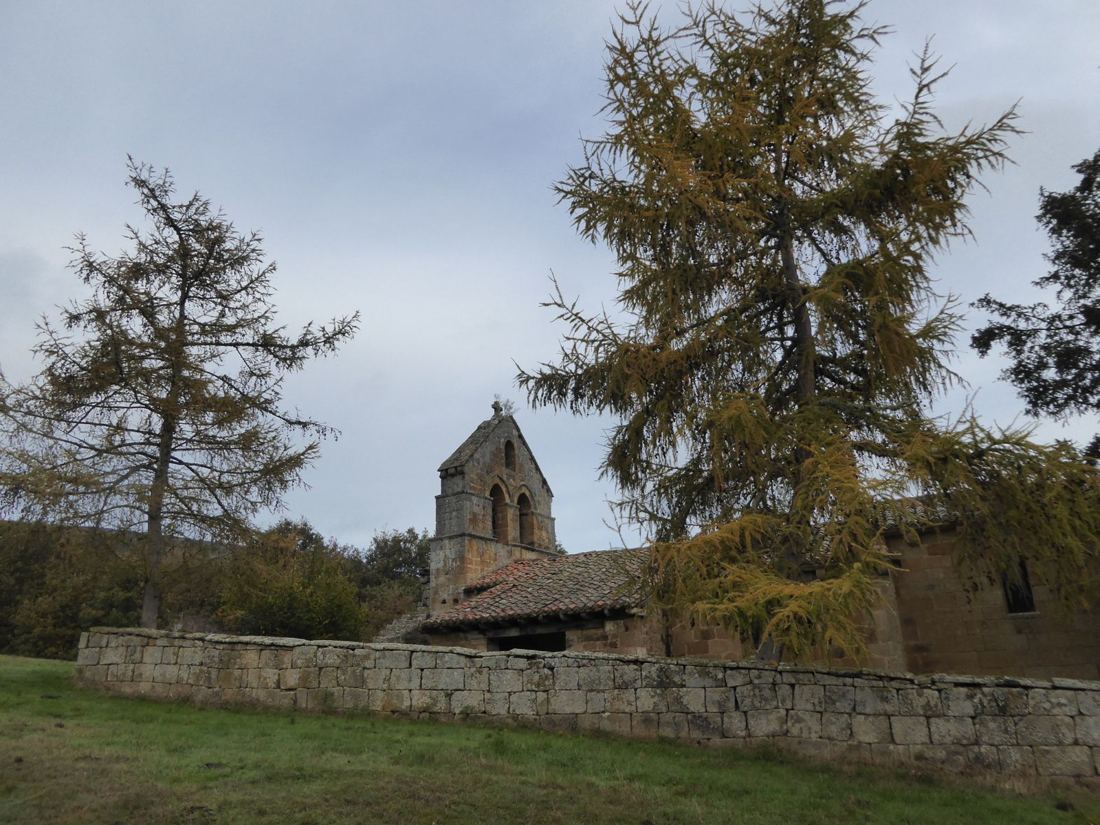
Riopanero's religious heritage is represented by the Church of the Immaculate Conception (Iglesia de la Inmaculada), listed in the Encyclopaedia of Romanesque Art in Cantabria.
Tour guide (in Spanish) Read the full guide · 11 stops
Románico tardío del siglo XIII, con su espadaña de tres cuerpos, una bóveda de nervios y un retablo pintado sobre el muro que permaneció oculto durante décadas.
Empezamos junto al atrio y rodeamos el templo por el sur.
1Riopanero, entre el Ebro y el Monte Hijedo
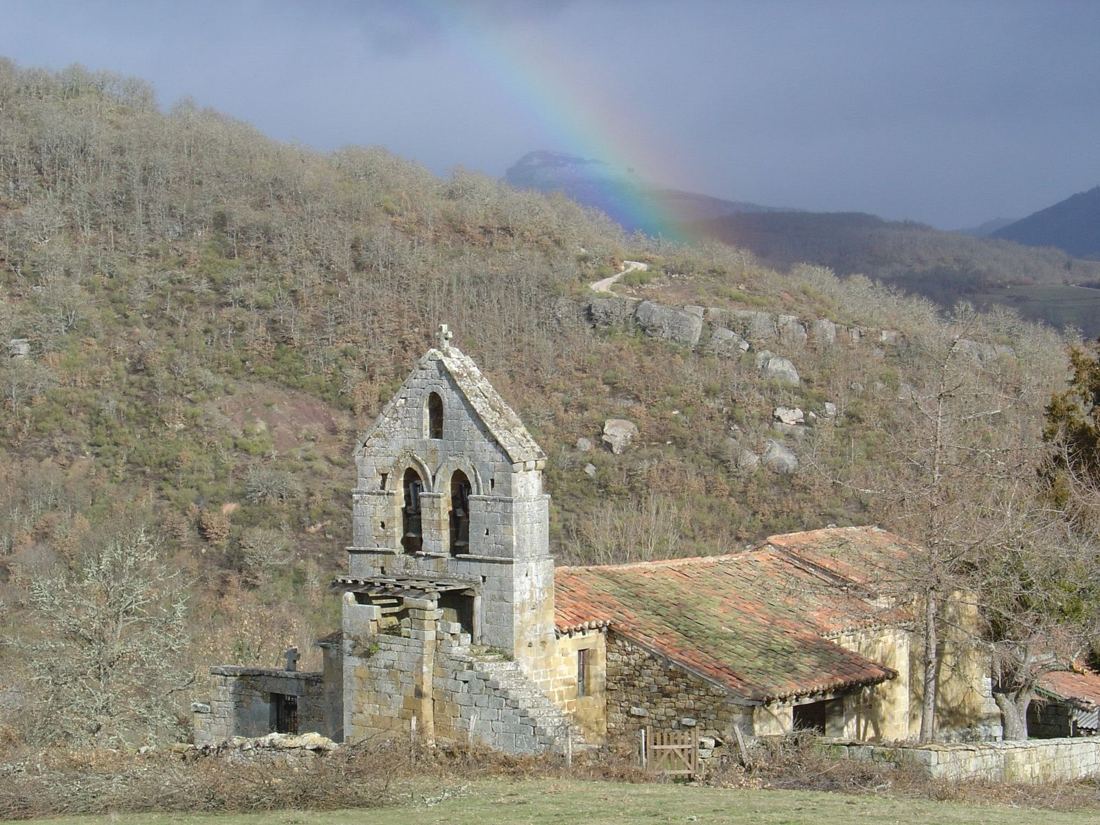
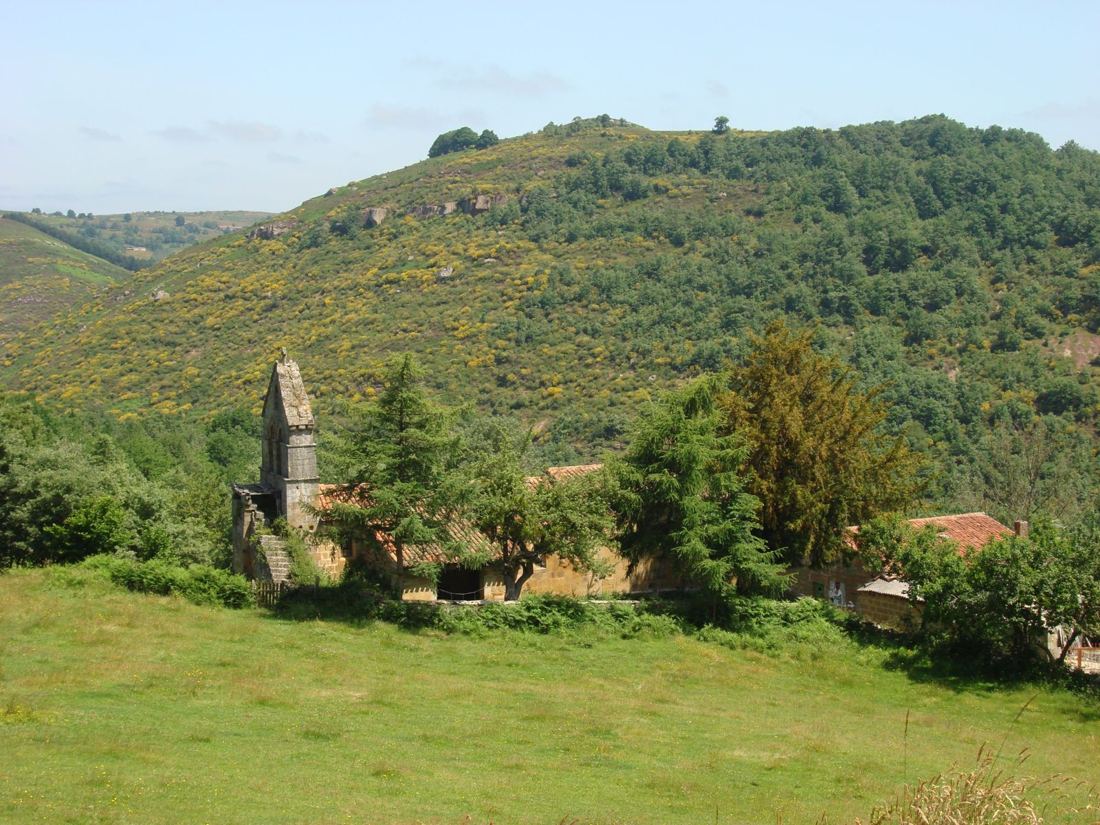
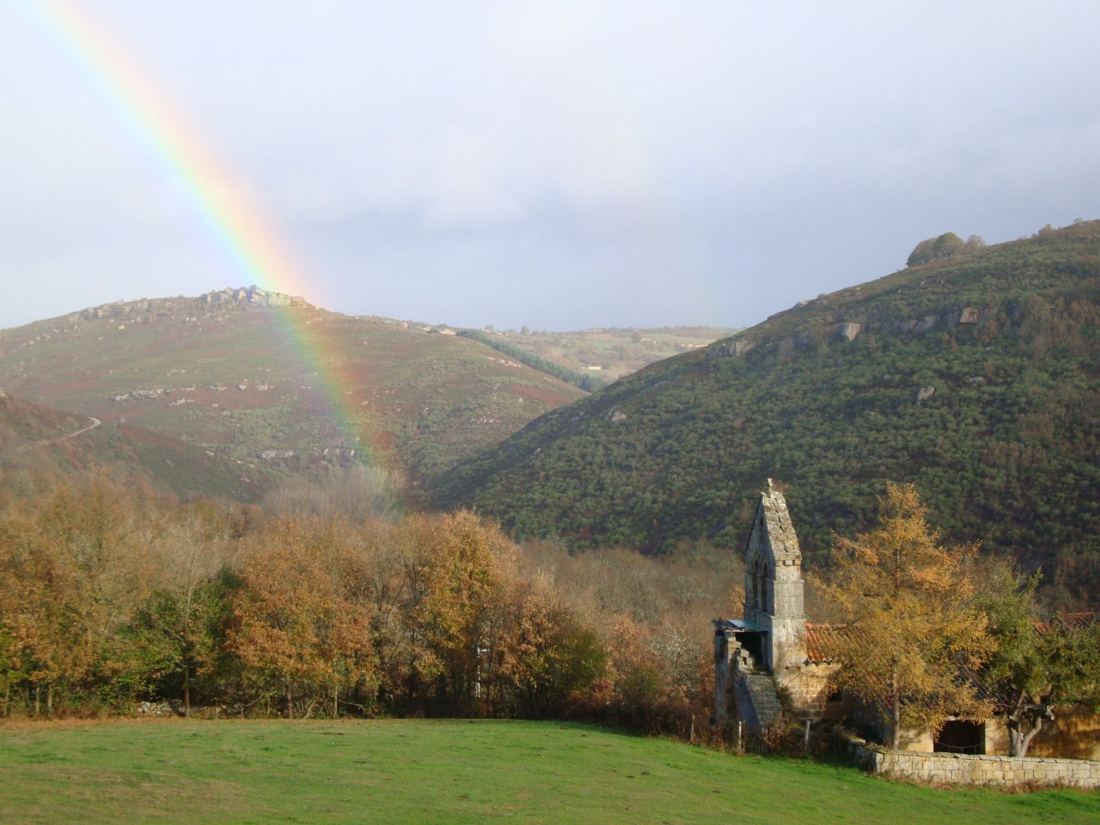
La iglesia a la entrada del pueblo, con las laderas del entorno del Monte Hijedo al fondo.
Riopanero ocupa el extremo oriental del valle de Valderredible, en la ladera occidental del monte Almirón, donde los arroyos Hijedo y Panero se unen al Ebro. Este último da nombre al pueblo, que se reparte en tres barrios: alto, medio y bajo.
El lugar aparece en los documentos desde el año 1185, en el archivo de la catedral de Burgos, y el Becerro de las Behetrías de 1352 lo llama «Río Panero». En 1651 su concejo aprobó unas ordenanzas propias.
Muy cerca se extiende el Monte Hijedo, uno de los bosques caducifolios mejor conservados de la península, con unas mil quinientas hectáreas. Y junto a la iglesia pasa el GR-99, el Camino Natural del Ebro.
2El tejo y el atrio
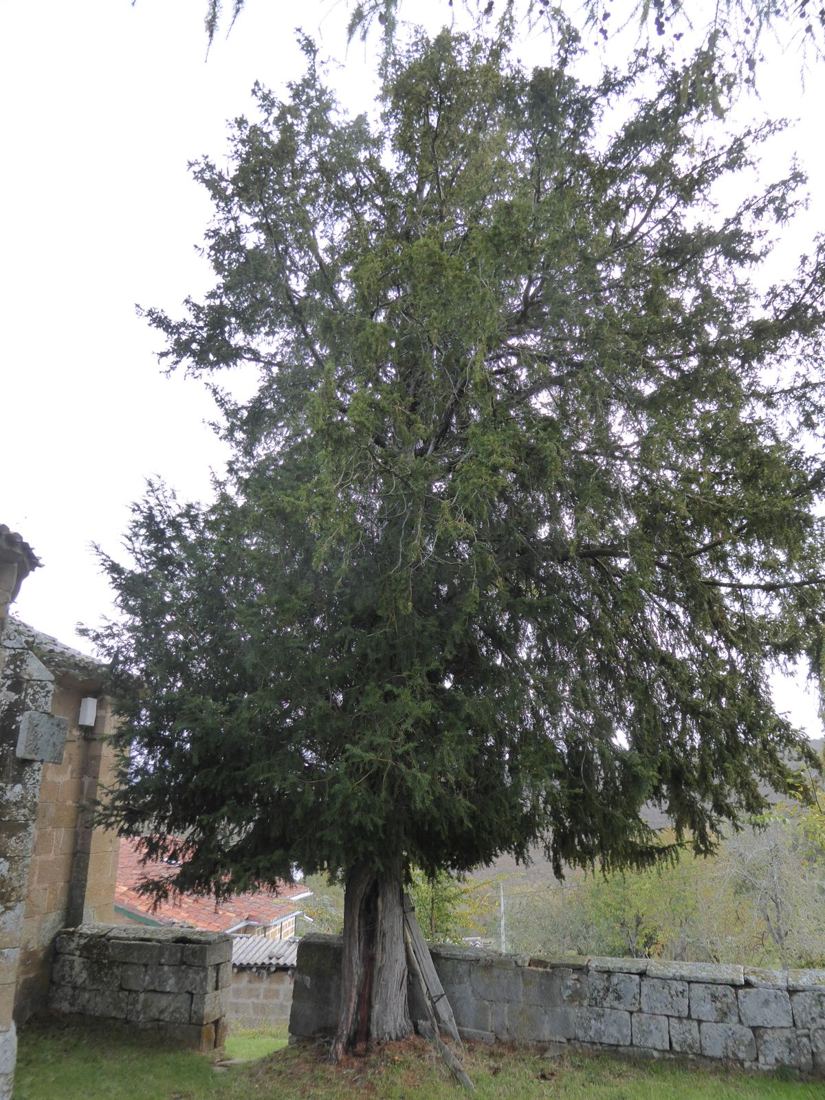
El tejo del atrio, con su tronco hueco y apuntalado.El muro del atrio y los alerces en otoño.
La iglesia está a la entrada del pueblo, rodeada por un muro de grandes sillares que cierra el atrio. Junto a él crece un viejo tejo que parece custodiar el acceso al templo. Su tronco, hueco y sostenido por un puntal, delata su edad.
En Cantabria es una tradición muy antigua plantar tejos junto a iglesias y ermitas. En muchos pueblos, el concejo se reunía a su sombra para tratar los asuntos comunes.
3La espadaña
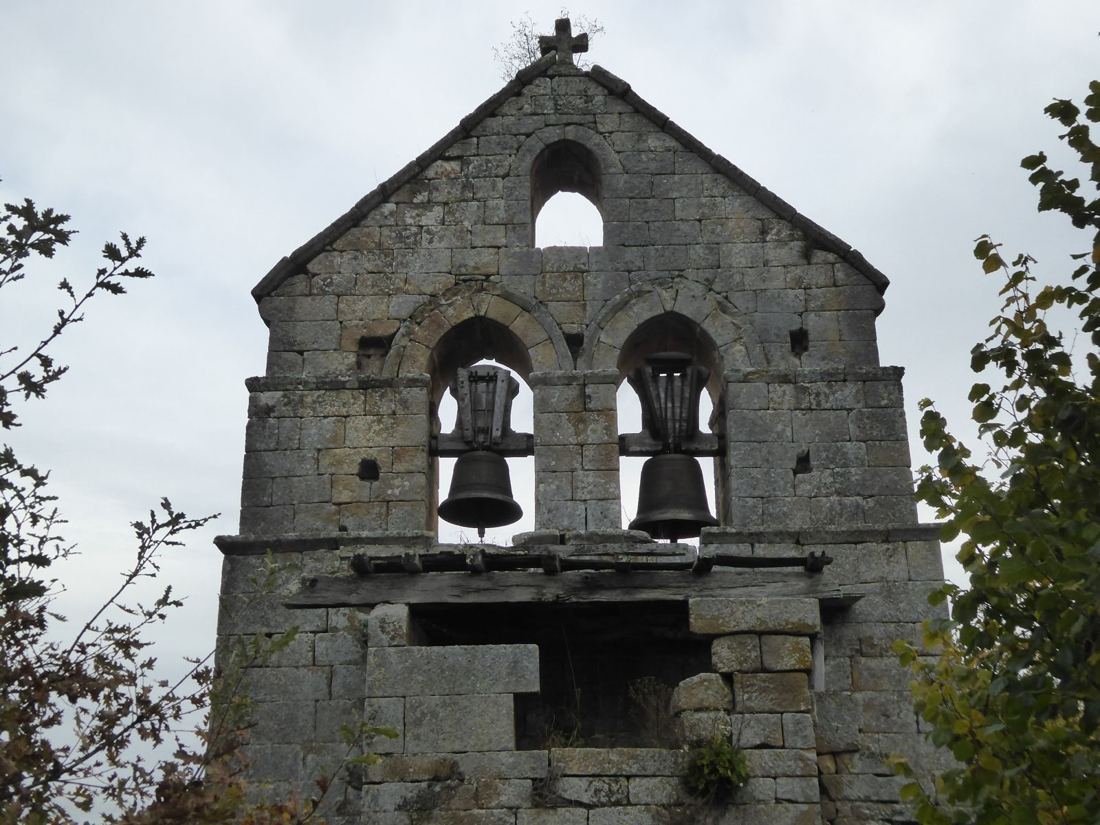
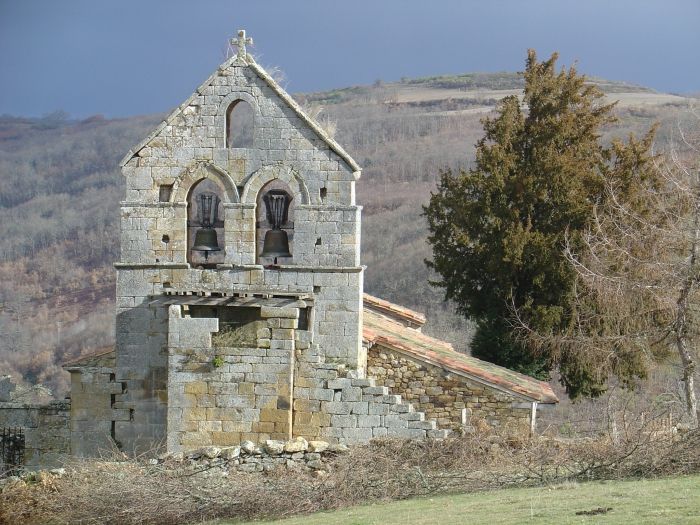
Los tres cuerpos de la espadaña, con sus dos campanas.La espadaña y su escalinata de piedra en otoño.
La espadaña es el elemento más destacado del conjunto. Es románica, aunque ya de transición, y está construida por completo en sillería. En Valderredible, una espadaña así anuncia siempre una iglesia parroquial o una ermita.
Tiene tres cuerpos y puede servir de modelo para todas las del valle. El primero, el más alto, llega hasta el alféizar de las troneras. El segundo lo ocupan dos troneras de arco apuntado, donde cuelgan las campanas. El tercero termina en piñón, con una sola tronera de medio punto, y se cubre con placas de piedra apoyadas en canecillos.
FíjateLa escalinata exterior que sube al campanario está hecha con peldaños de una sola pieza.
4Muros, canecillos y saeteras
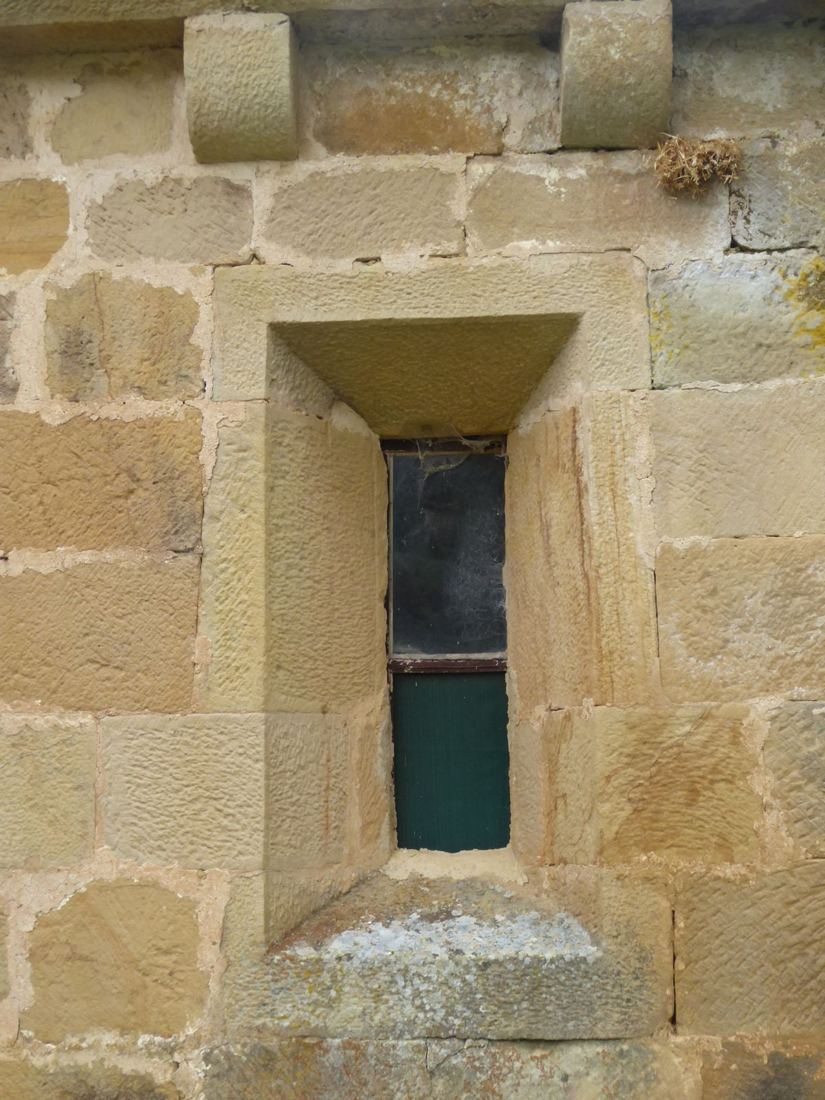
Sillería de arenisca y canecillos bajo la cornisa.Una de las saeteras, con los canecillos lisos encima.
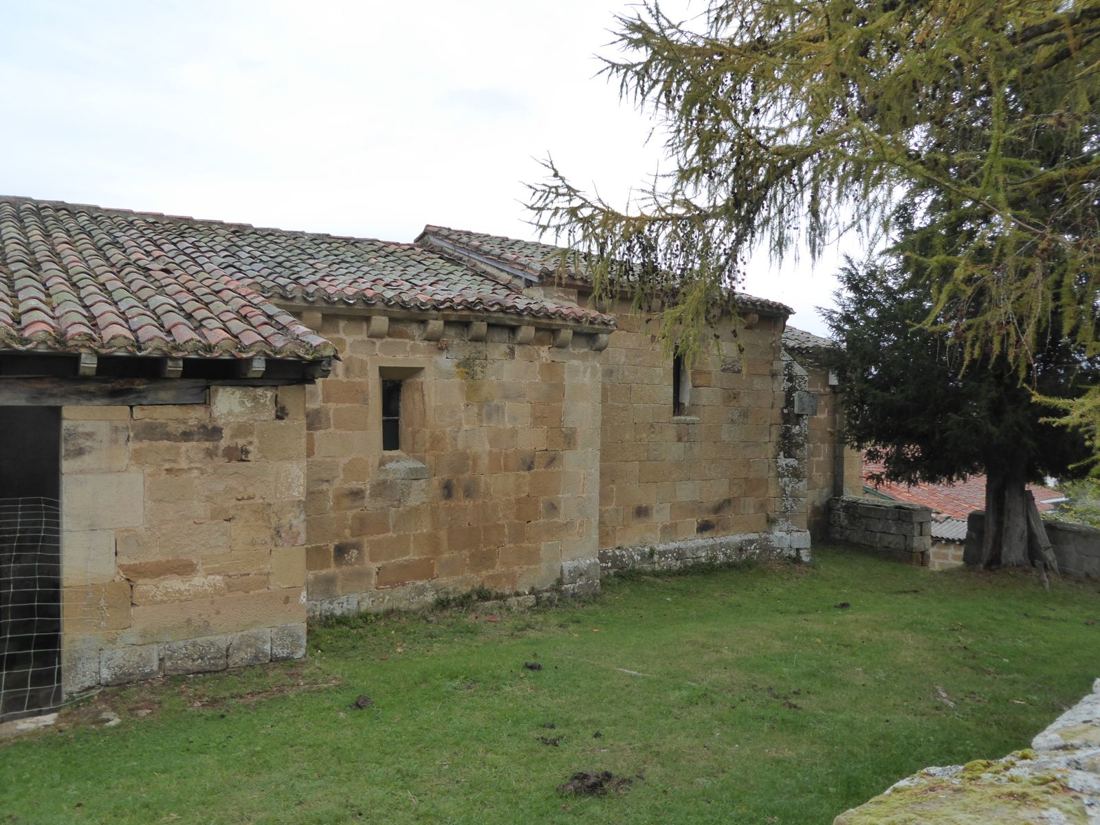
Los muros conservan sillares románicos de la vieja iglesia, levantada seguramente a finales del siglo XIII o ya en el XIV. Bajo el alero corre una cornisa biselada que descansa sobre canecillos de cuarto de bocel.
Ninguno de los canecillos tiene figuras. Es una estética austera, propia del románico rural de transición. La luz entra al interior por pequeñas ventanas en forma de saetera, estrechas por fuera y abiertas hacia dentro.
5Las cruces del muro sur
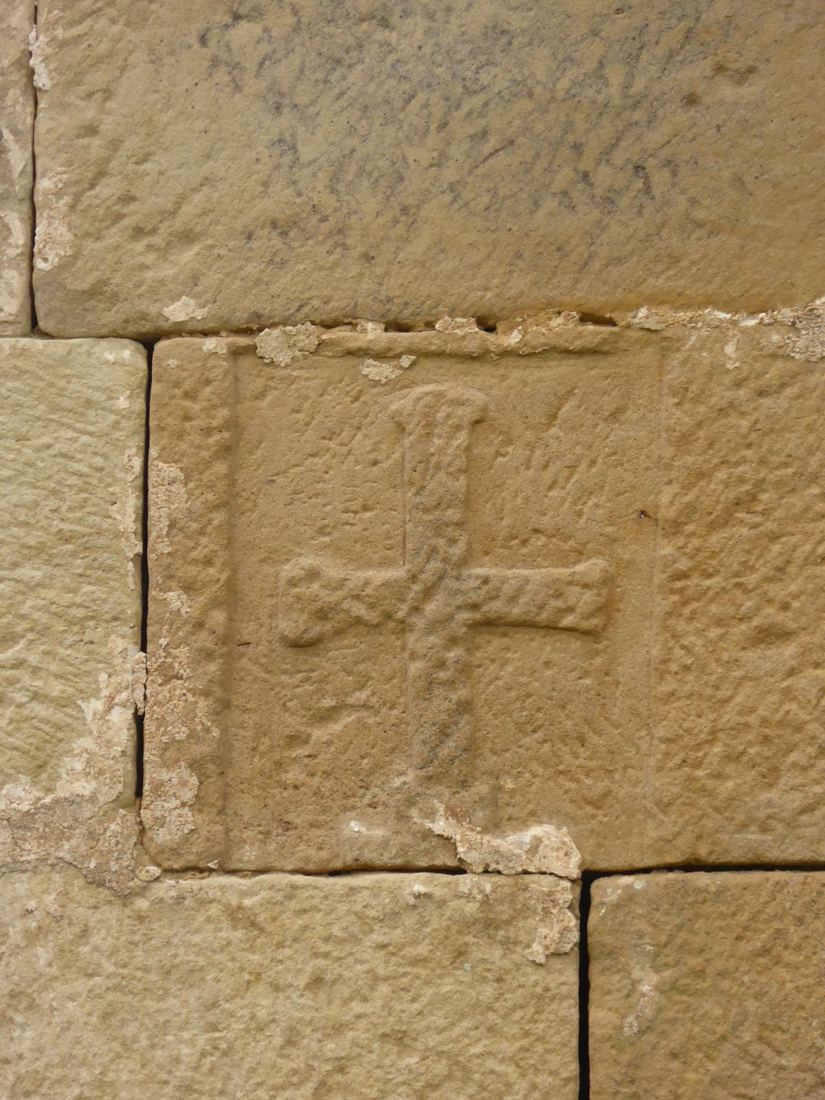
Cruz de tipo asturiano, inscrita en un rectángulo.
En el muro sur de la nave, cerca de la esquina, hay dos cruces labradas con poco relieve.
La primera está en la quinta hilada contando desde la cornisa. Es una cruz de brazos desiguales, con peana, inscrita en un rectángulo rehundido, y recuerda a la cruz asturiana. La segunda, en la novena hilada y algo más al este, es una cruz patada inscrita en un círculo. Las dos pudieron tallarse en época románica.
BuscaCuenta las hiladas desde la cornisa para encontrar la segunda cruz, la del círculo.
6El reloj de sol
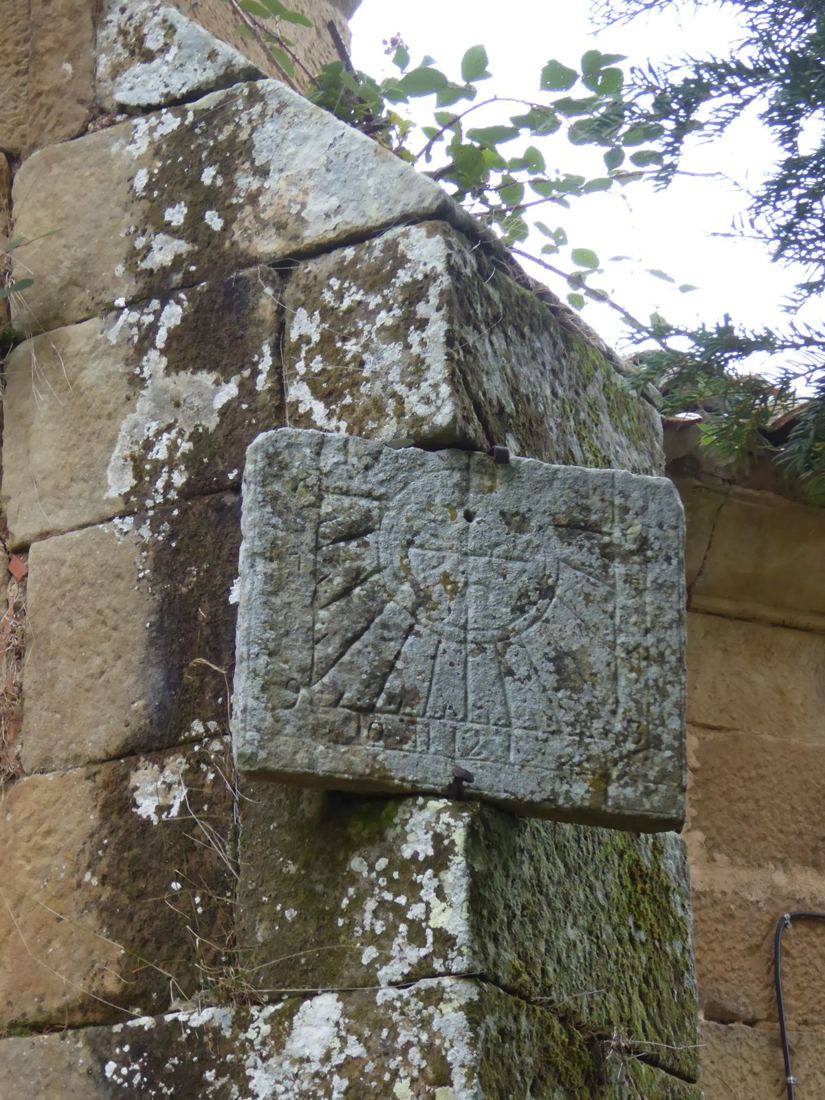
El reloj de sol, en la esquina de un contrafuerte.
En uno de los contrafuertes hay un reloj de sol, posterior a la construcción del templo. En la losa se ven las líneas de las horas, que parten del orificio donde iba el gnomon, la varilla que proyectaba la sombra.
Durante siglos marcó el ritmo de las labores del campo y la hora de acudir a los oficios.
IIInterior del templo
Entramos por el pórtico.
7La nave
La iglesia tiene una sola nave, de planta sencilla y alargada. Su armadura de madera, una cercha española, quedó oculta tras un falso techo plano, ya moderno, que sustituyó a una cubierta anterior.
Aun con estos cambios, el espacio conserva una atmósfera recogida y sobria, muy propia de una iglesia rural. Al fondo, el arco triunfal apuntado nos da paso a la cabecera.
8La cabecera: bóveda, ménsulas y clave
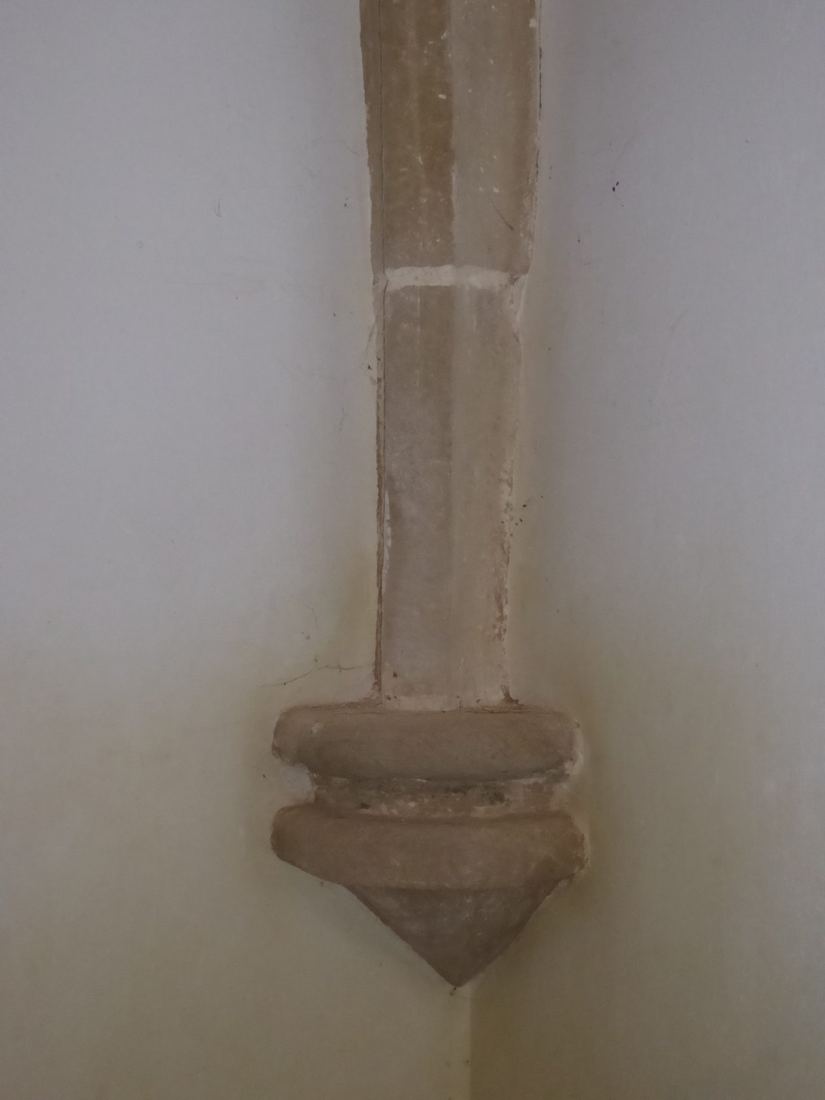
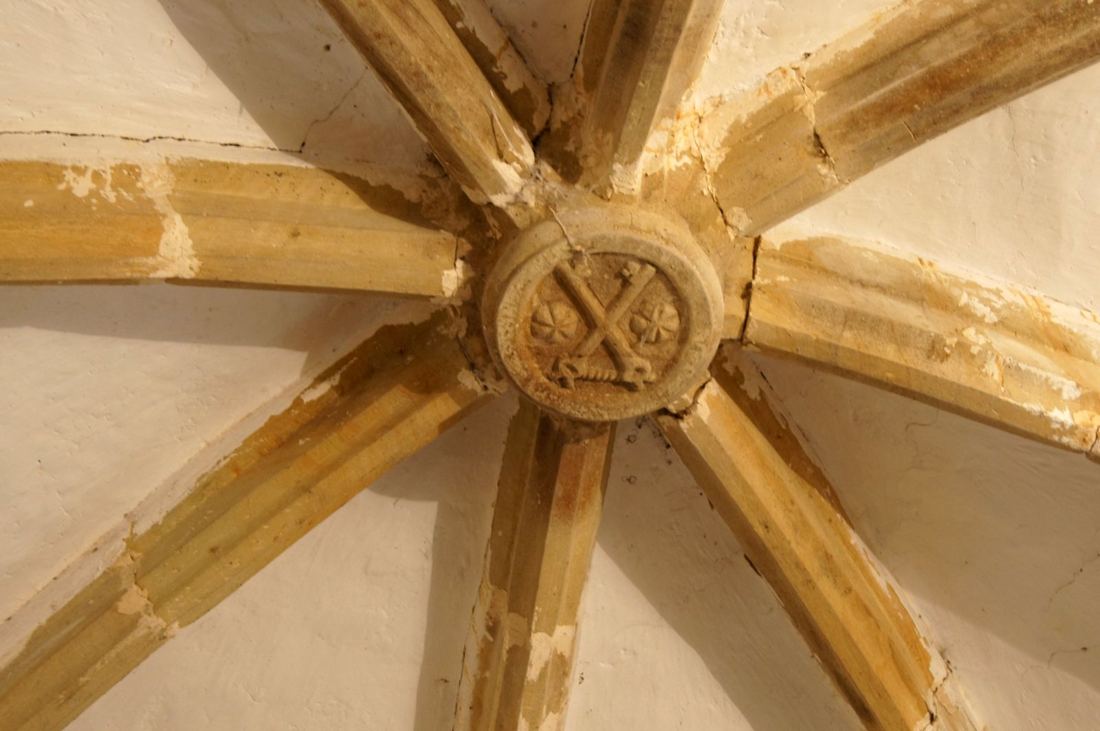
Ménsula goticista donde descansa uno de los nervios de la bóveda.Clave de bóveda con dos llaves cruzadas y rosetas.
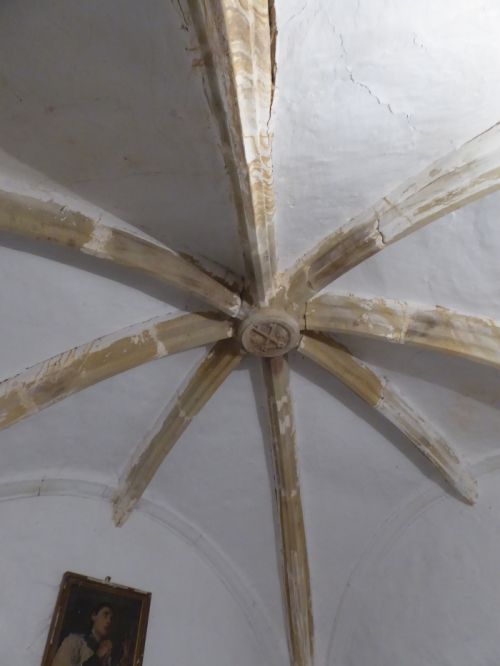
La cabecera es cuadrada y está cubierta por una bóveda de nervios de cuatro plementos. Los nervios bajan hasta los ángulos y descansan sobre ménsulas de aspecto goticista, como la que vemos en la fotografía, con dos molduras redondeadas y un remate en punta.
Es una solución de transición: anuncia el gótico, pero sin abandonar del todo la tradición románica. La sacristía también se cubre con arcos nervados.
Mira arribaEn la clave aparecen dos llaves cruzadas, atributo tradicional de san Pedro, entre dos rosetas.
9El retablo del siglo XX
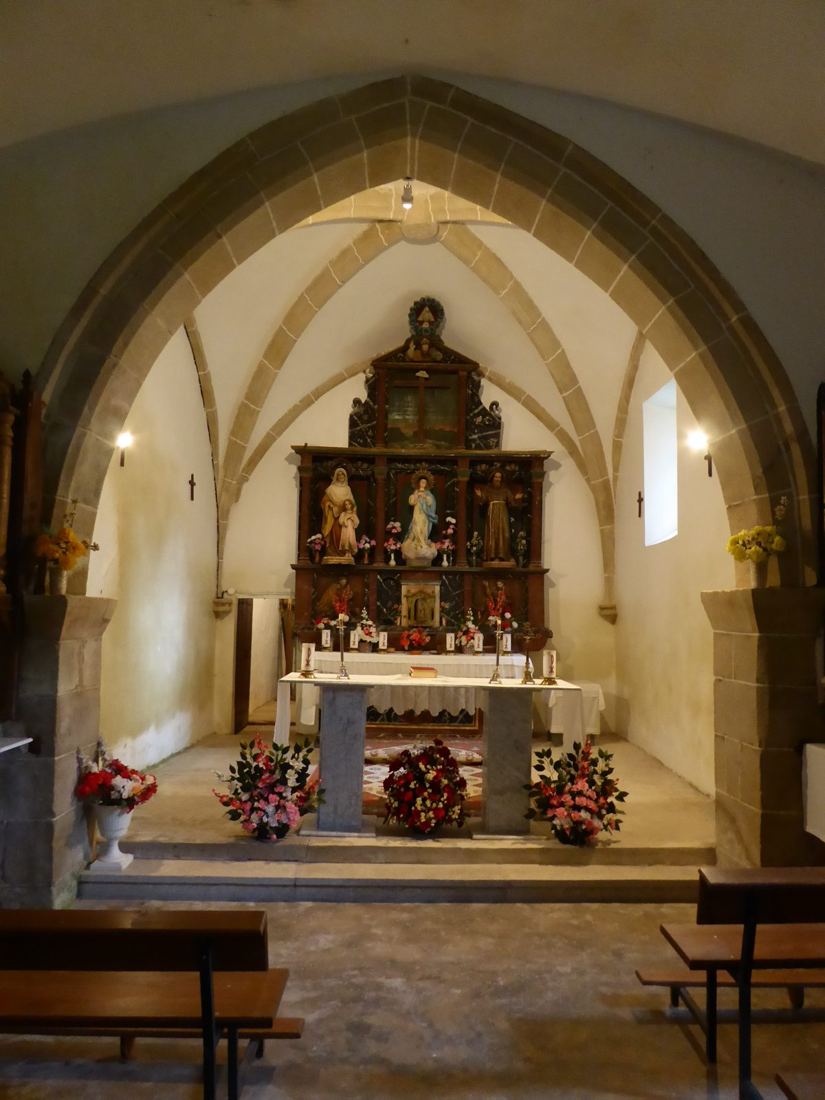
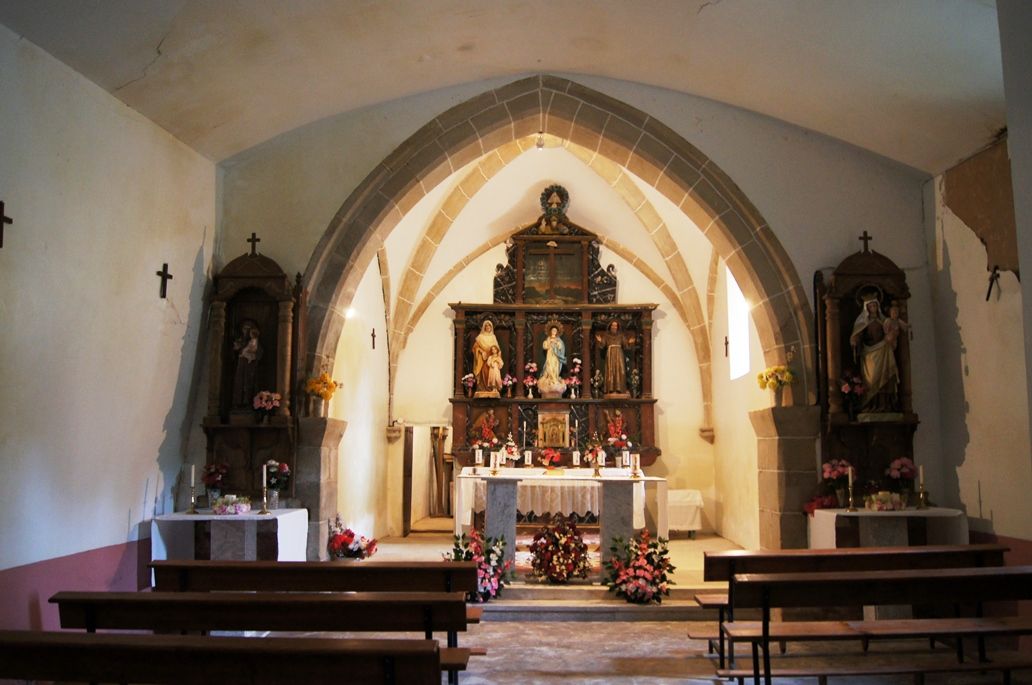
La cabecera con el retablo instalado en el siglo XX, antes de que salieran a la luz las pinturas.
Así se veía la cabecera antes de que aparecieran las pinturas. Bajo el arco triunfal y la bóveda de nervios se levantaba un retablo de madera instalado en el siglo XX.
En su calle central estaba la imagen de la Inmaculada, titular de la iglesia, flanqueada por santa Ana con la Virgen niña y por san Francisco de Asís. Detrás de este retablo, cubiertas por él y por capas de cal, permanecían ocultas las pinturas murales que vamos a ver ahora.
10Las pinturas murales
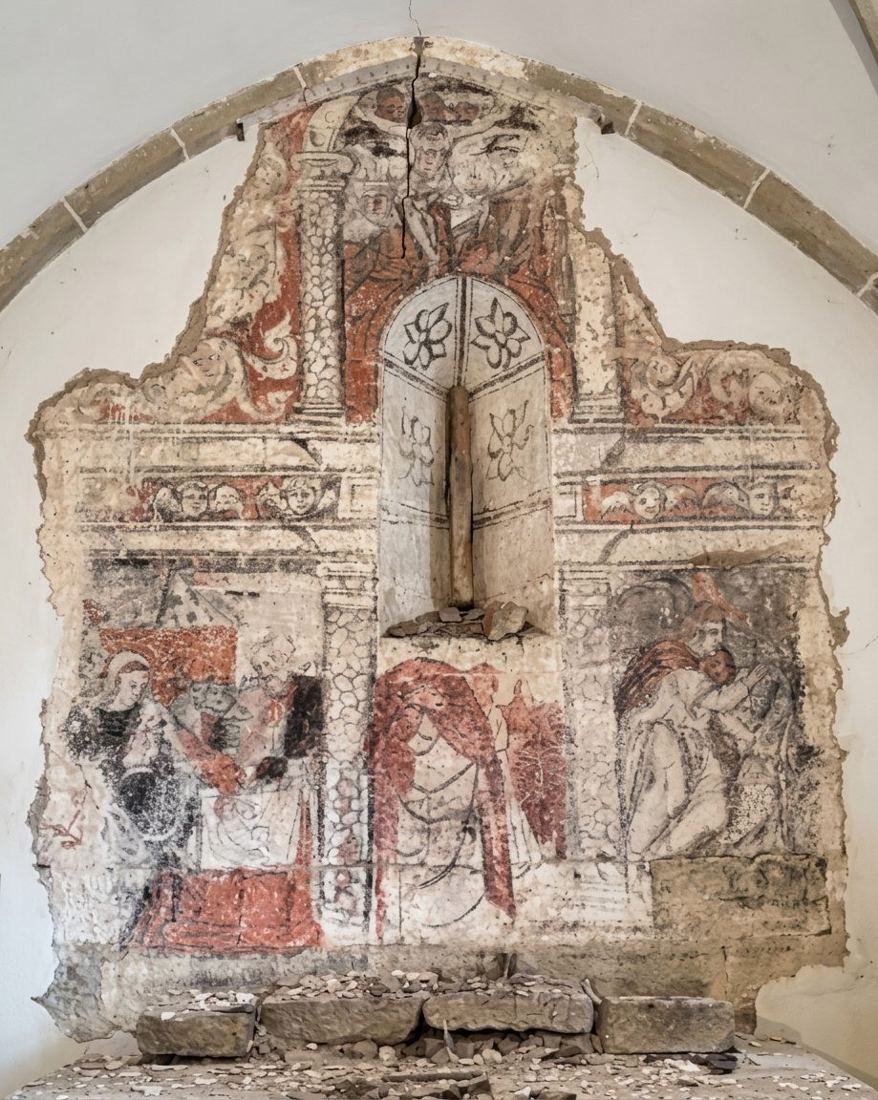
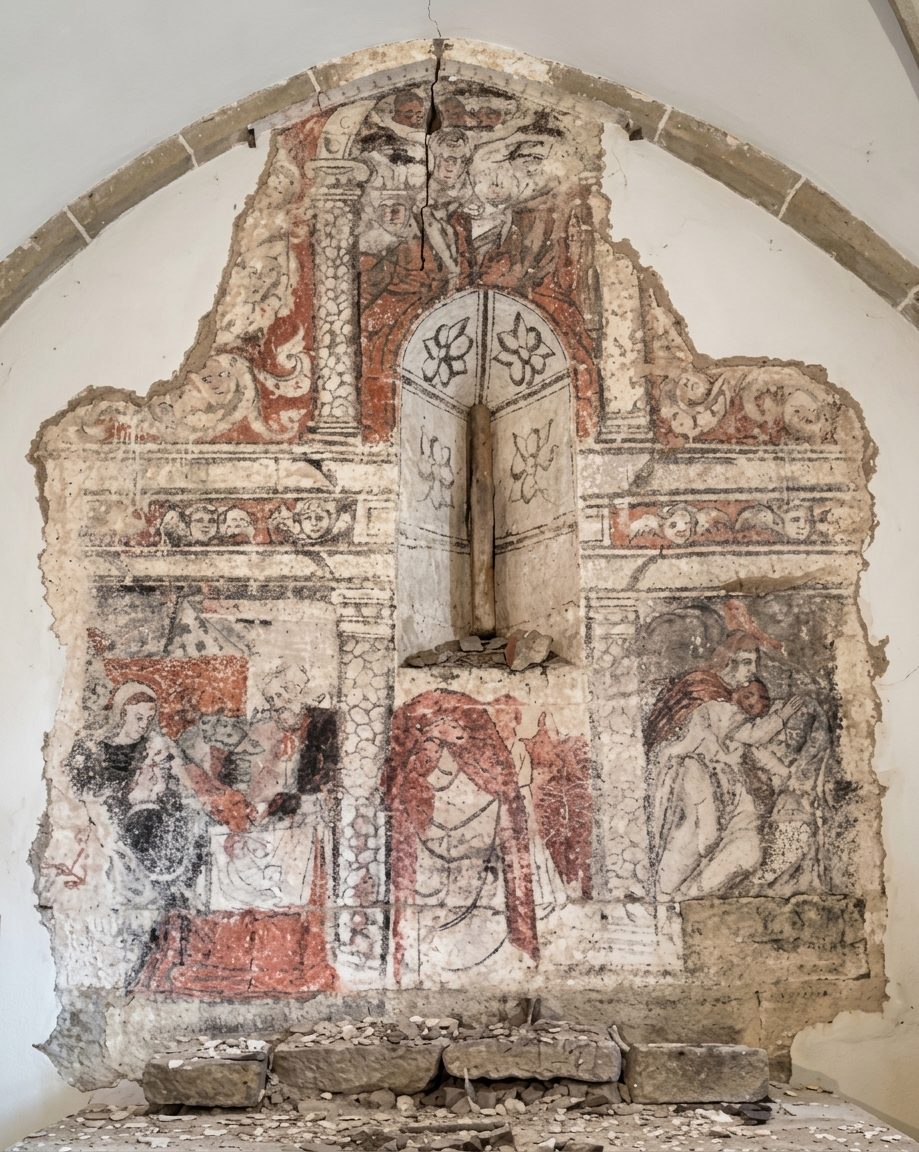
El retablo pintado sobre el muro de la cabecera.
Al retirar el retablo apareció en el muro un retablo pintado. El pintor fingió una arquitectura completa: columnas decoradas con escamas, entablamentos con frisos de cabezas de querubines y, a los lados del remate, roleos y grutescos. Es un repertorio decorativo propio del Renacimiento.
En el centro se abre una hornacina, pintada por dentro con flores, donde se colocaría una imagen. En el remate, partido por una grieta, se reconoce un Calvario, con Cristo en la cruz rodeado de figuras.
En el cuerpo bajo hay tres escenas. A la derecha, dos figuras se abrazan; podría tratarse del abrazo de san Joaquín y santa Ana ante la Puerta Dorada, un tema muy ligado a la Inmaculada Concepción. A la izquierda, varias figuras se reúnen en un interior, y en el centro destaca una gran figura cubierta con un manto rojo.
FíjateCon solo tres colores, rojo de almagre, negro y blanco de cal, el pintor convirtió el muro en un retablo.
11La pila bautismal
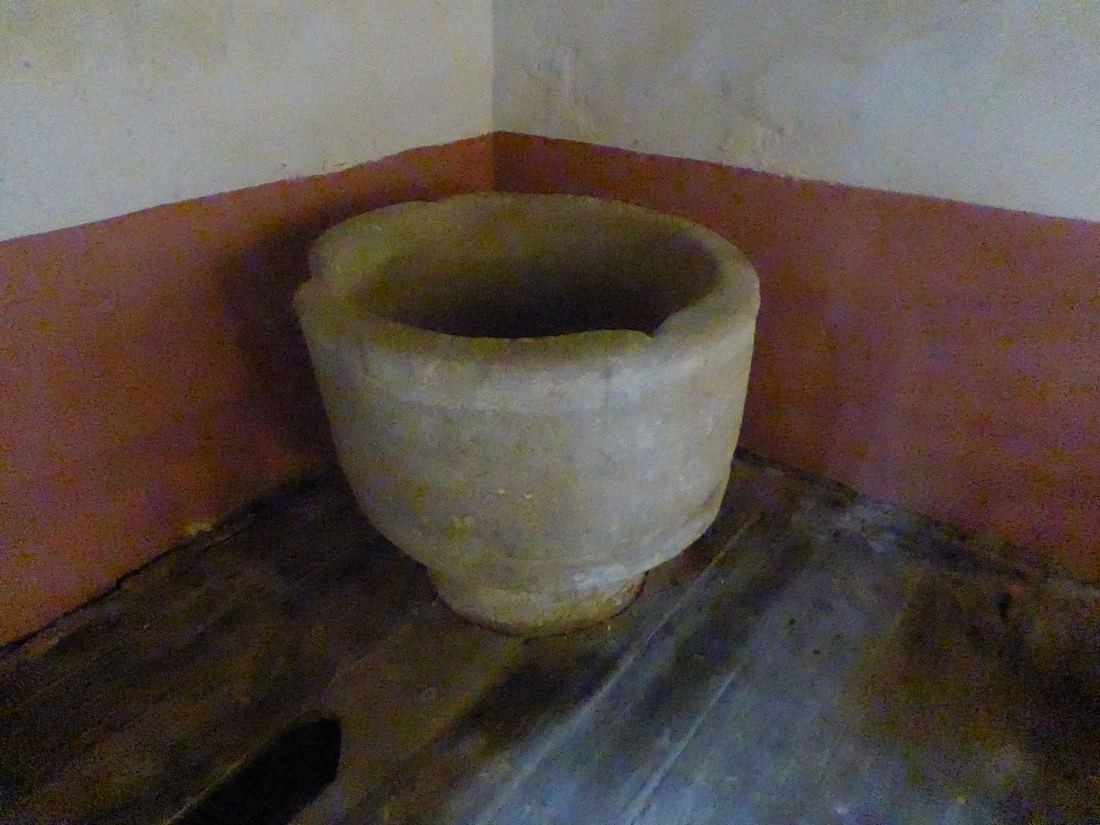
La pila bautismal románica.
Terminamos junto a la pila bautismal. Es de tipo románico, de una sola pieza y forma cilíndrica, sin inscripciones ni decoración. Solo dos boceles rompen la monotonía de la piedra: uno poco marcado en la boca y otro mucho más acusado en el fondo.
Mide setenta y tres centímetros de alto con su base, y la cuba tiene ochenta y seis centímetros de diámetro.
Aquí termina la visita. Gracias por acompañarnos. Si quieres ayudar a conservar esta iglesia, puedes hacer un donativo a través de Dono a mi Iglesia.
Ayuda a conservar la iglesia
La espadaña tiene sillares desplazados y grietas, y las goteras están pudriendo la armadura del tejado. Puedes colaborar con su mantenimiento y conservación mediante un donativo.
Textos basados en la ficha de la Enciclopedia del Románico (texto: MAGG), la guía País Románico y el informe de estado de la iglesia (2025).
News · October 2026
15th-century wall paintings found behind the altarpiece
During restoration work by the Diocese of Santander, the dismantling of the late 19th-century altarpiece revealed wall paintings probably dating from the 15th century. Villagers already suspected something was there: shining a torch behind the altarpiece, you could see a patch of red.
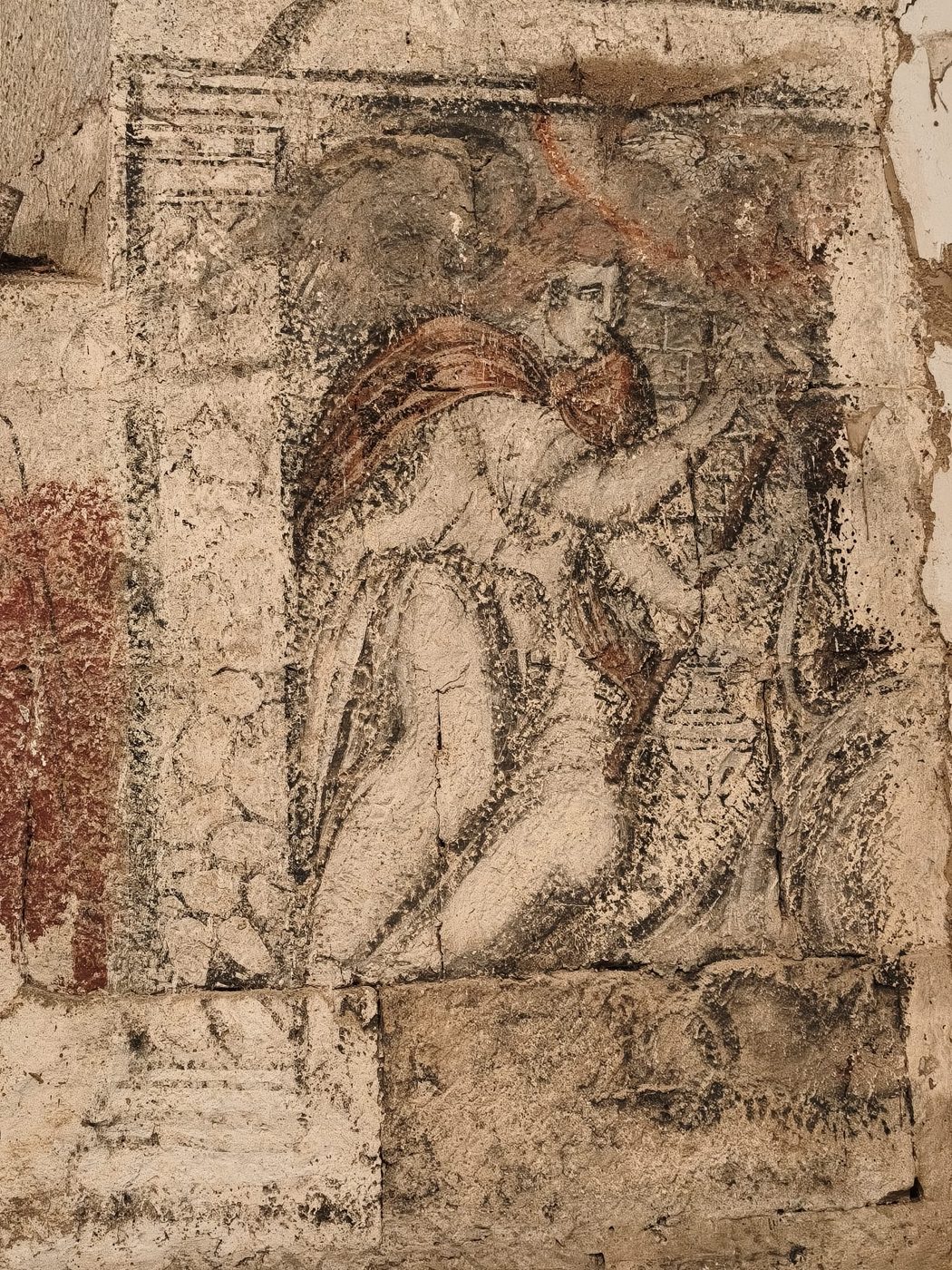
What has come to light is part of a mural about four metres wide and six metres high, showing the Archangel Gabriel (an Annunciation), a Nativity with the ox and the mule and, at the top, a Calvary. Restorer Lydia Quevedo, PhD in Fine Arts, of the Fundación Santa María de Toraya, who removed the altarpiece, highlights its high artistic value: the figures have movement and are framed, far from the usual stiff, flat compositions.
Much remains to be studied. More of the work is likely to appear under the whitewash on the walls, and there are signs of an even older mural beneath. The Diocese has reported the find to the regional Directorate-General for Culture so that the paintings can be assessed and protected.
The whole mural, uncovered after the altarpiece was removed. At the top, the Calvary.Detail: the Archangel Gabriel, from the Annunciation.
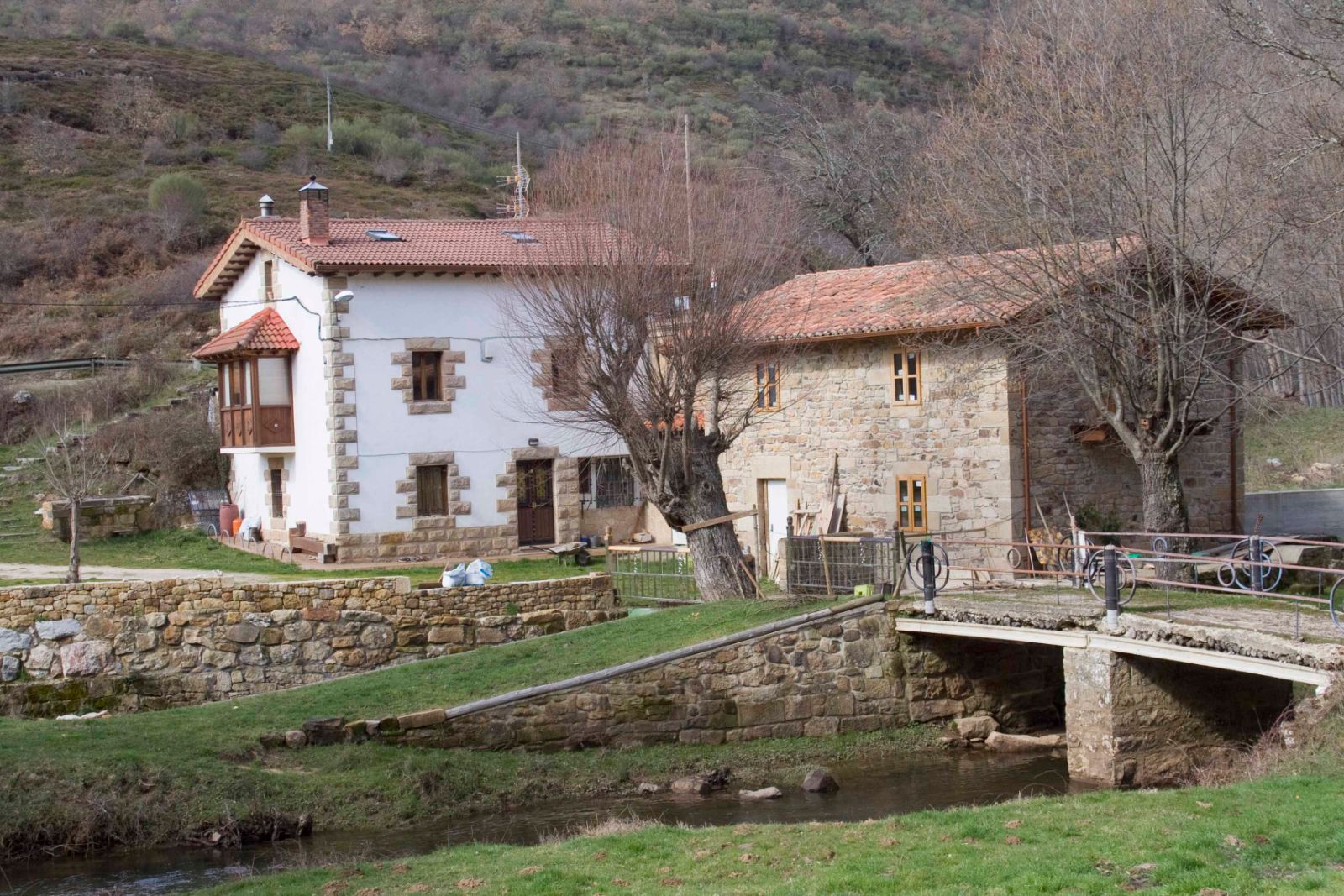
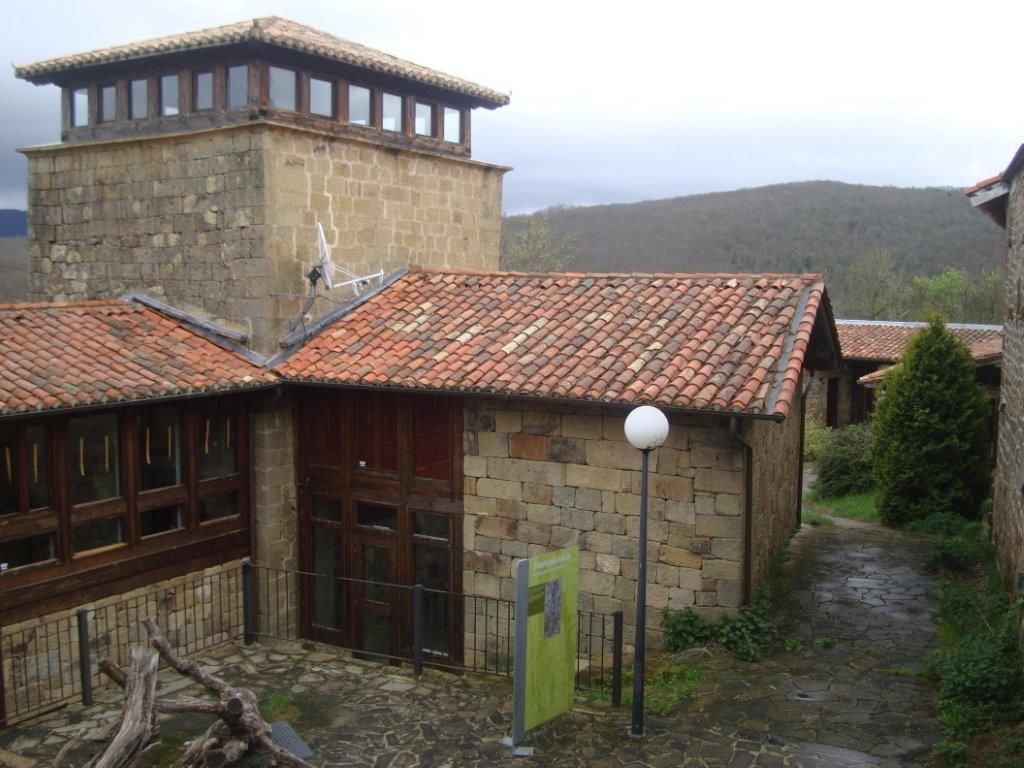
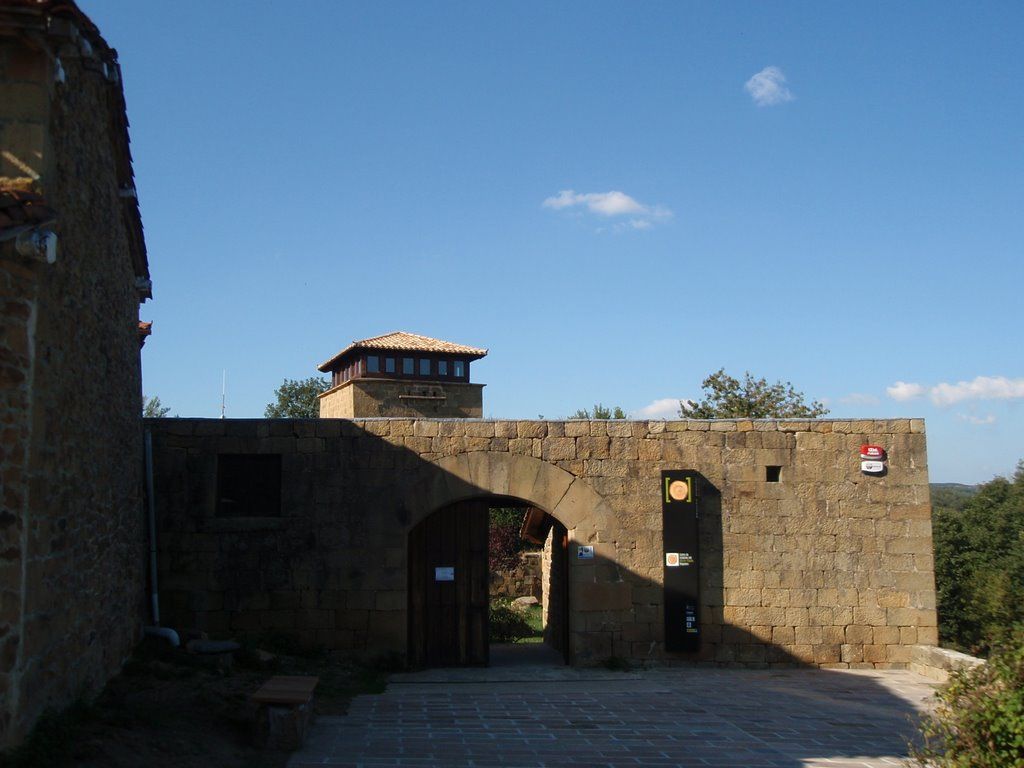
Among the secular buildings, besides several houses that keep their traditional construction, the most notable is the Casa-Torre de los Capellanes (17th–18th centuries), a tower house that now holds the Monte Hijedo Visitor Centre.
The school, built in 1920 and in use until the late 1960s, has been turned into a hostel and is regularly used as the village council house.
There were several mills, some of which survive as ruins; today only the restored Riopanero Mill remains complete.
Notice board
News
Official village council notices and news from Monte Hijedo and the valley (in Spanish).
Latest news
Updated automatically from what the media publish about Riopanero, Monte Hijedo and Valderredible (in Spanish).